Playtest: Kursk in Finland – The Battle of Tali-Ihantala 1944

I recently spent some time testing Perry Moore’s new game Kursk in Finland. The game depicts the decisive battles between the Soviet Union and Finland in the summer of 1944. Tali-Ihantala refers to two towns in what was then Finland—now part of Russia—where the mighty Red Army was repulsed and Finland effectively preserved its independence.

The Soviet summer offensive of 1944—Operation Bagration—was a decisive blow against the German Army Group Center. Some weeks before Bagration began, the Soviet Union launched the Vyborg–Petrozavodsk Offensive against Finland, aiming to force Finland out of the war. Three Soviet armies attacked on the Karelian Isthmus, while two more advanced into eastern Karelia.

With overwhelming firepower, the Red Army pushed forward and ultimately captured Finland’s second-largest city, Vyborg (Viipuri). (Side note: my mother was born there.) Facing this powerful enemy, Finland requested support from Germany. Some limited—but crucial—assistance arrived: Panzerfausts and Panzerschrecks, Detachment Kuhlmey (Ju-87s and Fw-190s), an infantry division, and a half-strength assault gun brigade. Not much in the context of this enormous struggle, but just enough to stiffen the defense. Even so, the Soviets outnumbered their opponents by roughly 20:1 in aircraft and armor.

The game begins as the Soviets continue their offensive after taking Vyborg. The town of Tali lies directly in their path. The Finnish army in the area consisted mostly of regular infantry, while the Armored Division was deployed in an adjacent sector.
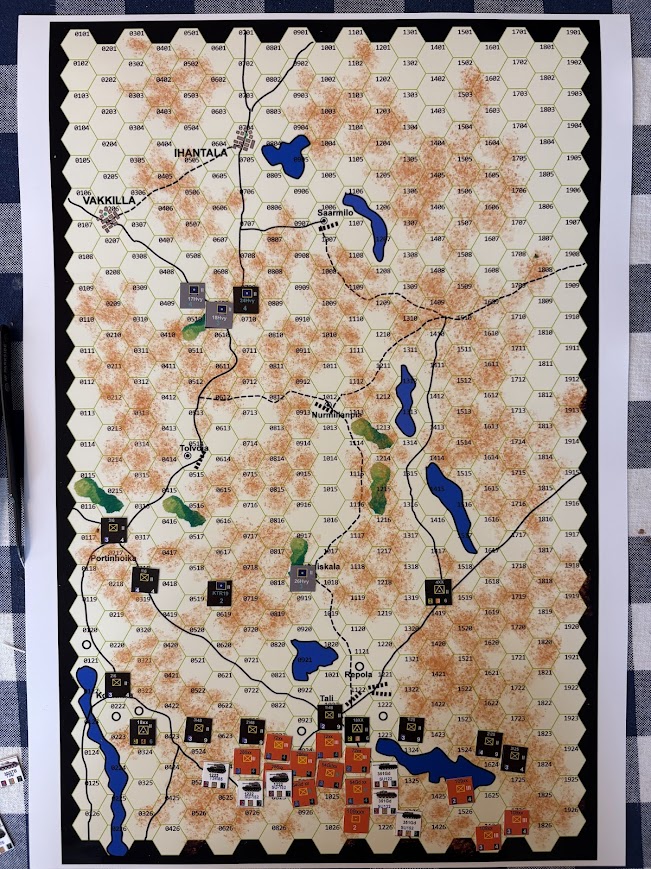
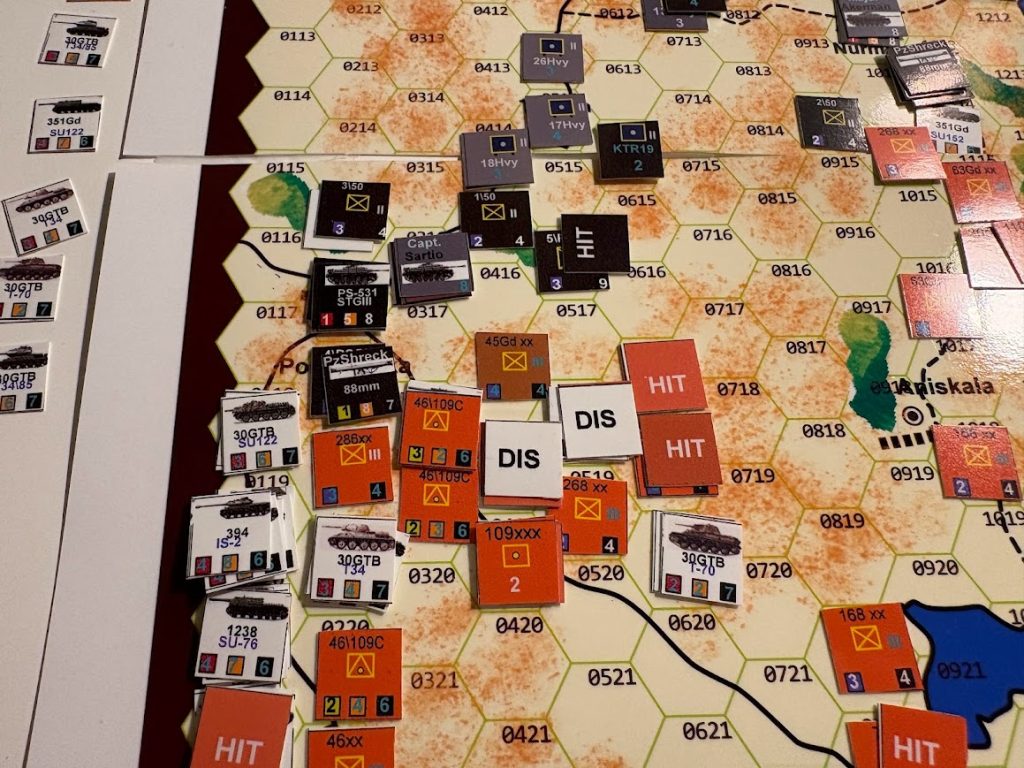
Rough starting locations on the standard map.

As a print-and-play game, the quality of the map and counters is largely up to the player. I didn’t spend too much time on production quality—as you may notice—particularly on the counters. They’re printed on glossy photo paper on one side and adhesive paper on the other. Good enough for testing purposes.

I won’t dwell too much on the “test” aspect, and will focus more on the game itself. Historically, the Soviet onslaught was halted through massed artillery fire and aerial bombardments that crushed concentrated Soviet armor and infantry. The same holds true in the game: these are the decisive factors. Infantry feels somewhat fragile and slow, and the fine line between victory and defeat depends on the effective use of heavy assets.

The Finns historically concentrated more than half of all available artillery in the entire army to counter the Soviet attack. Batteries from multiple divisions, supported by corps-level heavy artillery, concentrated their fire on single points—often obliterating enemy units before they could even advance. In the game, if you gain air superiority, you can bombard any hex on the map. Artillery, however, requires spotting, so many tempting targets remain untouchable.
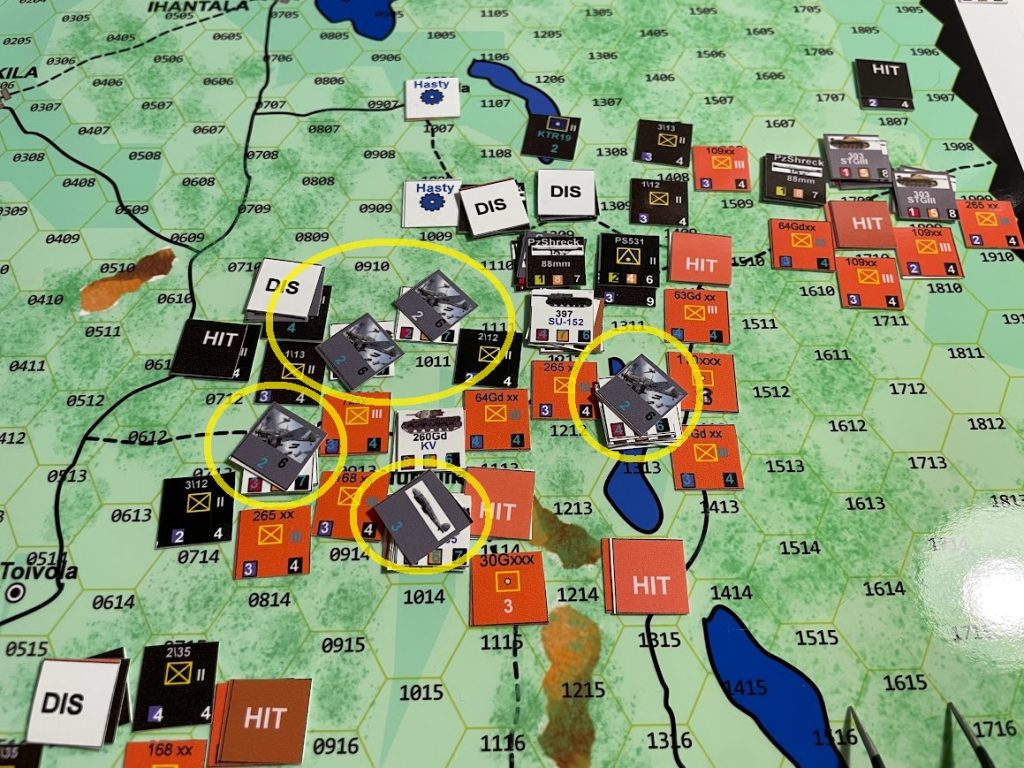
Concentrated air support can bring heavy firepower to any hex on the map. In this rare moment, Det. Kuhlmey delivers lethal packages. NOTE: I have edited the map file to make it… greener.
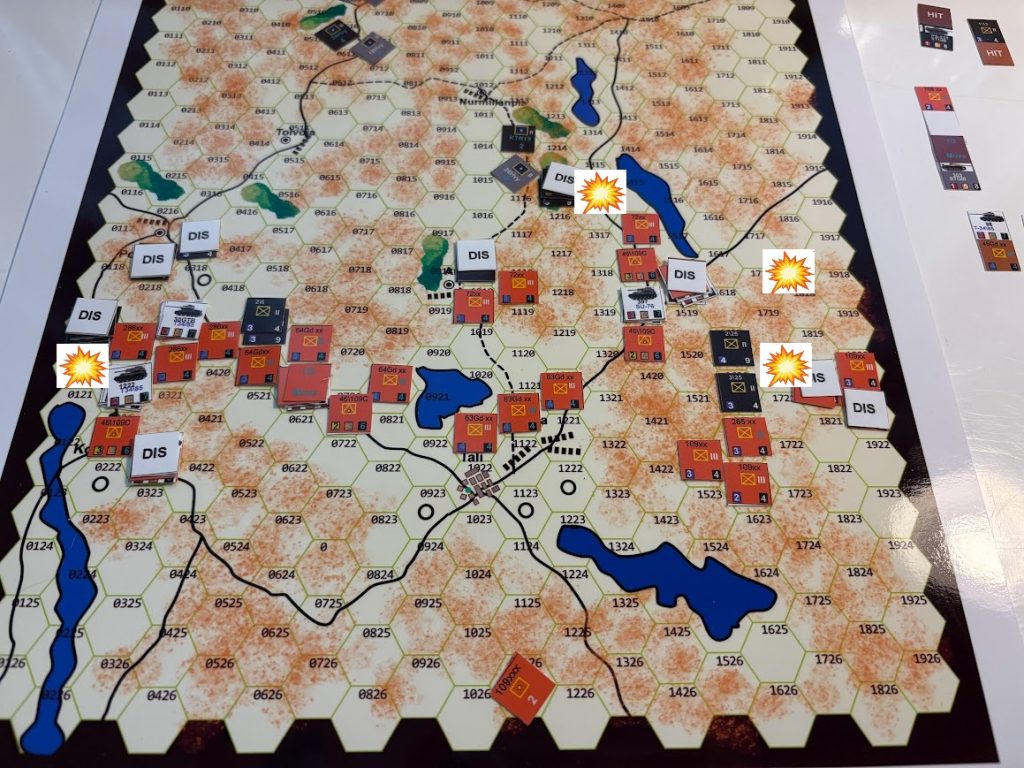
Artillery is the king of the battlefield—especially in this game. It will frustrate the Soviet advance time and time again.

The game system uses a fairly standard IGOUGO structure, with clearly defined segments for bombardment, prepared attacks, and movement + mobile attacks. Zones of Control behave as expected, and a disrupted unit loses its ZoC, allowing the enemy to bypass it easily. Due to their heavy armor, the Soviet player is largely constrained to road networks, while the Finnish player aims to block those roads, bypass strongpoints, and encircle powerful enemy concentrations.

Most of the map is forested, which restricts movement. There is randomness in both artillery and air support availability, as well as in combat results. Heavy IS-2 tanks and SU-152 assault guns are formidable Soviet assets. The Finns receive Panzerschrecks and StuG III assault guns as reinforcements. Even the tiny T-26 tanks and BT-42 assault guns are useful—they’re fast and project a Zone of Control. Panzerschreck teams can also be repositioned to stop or delay breakthroughs.
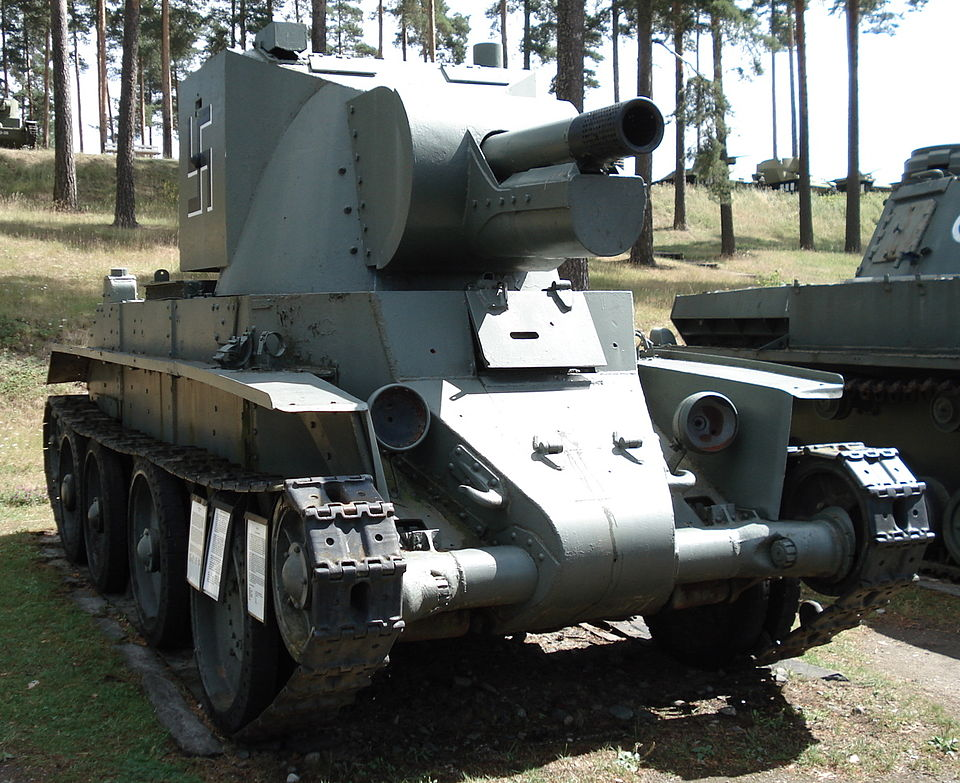
Image: https://en.wikipedia.org/wiki/BT-42#/media/File:Bt42_parola_2.jpg

While it’s possible to create defensive stacks that are immune to direct attack, they can still be bombarded into retreat and disrupted, causing them to lose their ZoC. Artillery and air support levels vary from turn to turn: air support is randomized every time, while artillery may receive additional ammunition if the Dice God is favorable.

The Finnish player must initially delay the Soviet advance as effectively as possible. As always, this is a balance between preserving strength and conceding ground. Once the Finnish counterattack begins, the roles partially reverse—not completely, but enough for the Soviets to start feeling the pressure. A change in initiative can even result in a double turn.
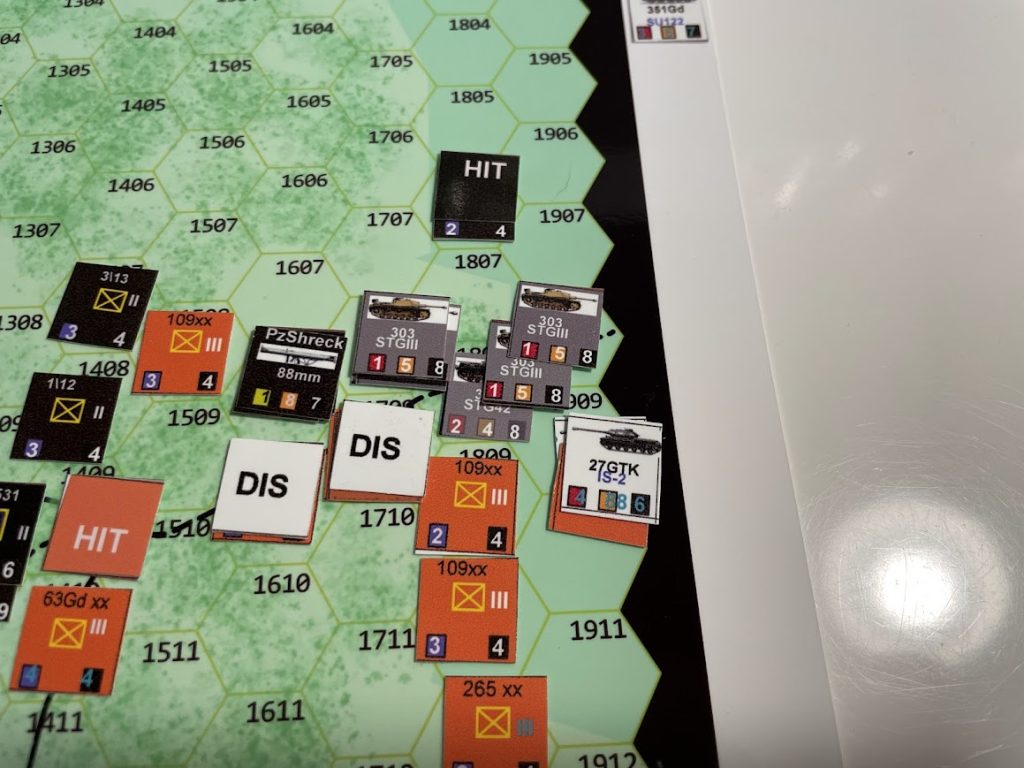
Blocking the Soviet advance. There may be a race to get some units to exit the map for a quick victory. Green is not the standard map color.

The Soviet player wins either by exiting enough units off the map or by having more victory points at the end of the game. Victory points are awarded for capturing villages and towns, as well as for destroying enemy units. Neither path is easy. Because the defender allocates hits, losses can be spread across units in large stacks. I usually played with a house rule to mitigate this, though that was purely a personal choice. For the Finns, success depends on holding as many locations as possible while steadily inflicting casualties on the Soviet forces.
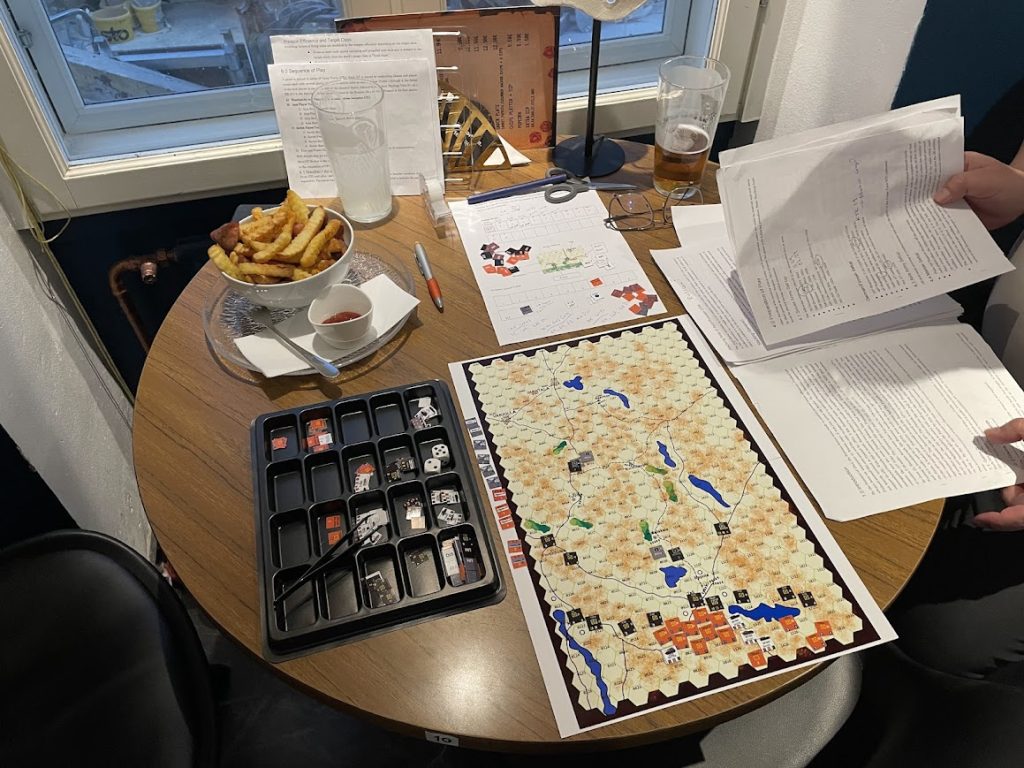
The map is quite compact. Unfortunately, the fries are not included.

A typical session lasted around 4–6 hours for me. I never quite reached the 2-hour playtime that some other testers reported—maybe that’s just me. In any case, you should be able to complete a full game in an evening and still clear the table for something else afterward.
1758 Fort Carillon – Vassal Tutorial – Afternoon of July 7th (part 2)

Going into the afternoon phase, I don’t feel the British are in a particularly strong position. Their troops are spread thin, although the breakthrough in the line is exploitable. There was no French counter-attack, as only a few powerful units were in the vicinity and the French chose not to risk losing them in a potentially failed assault. British success here might force the French to act—perhaps even pulling completely out of the fortified line. That would be total chaos.

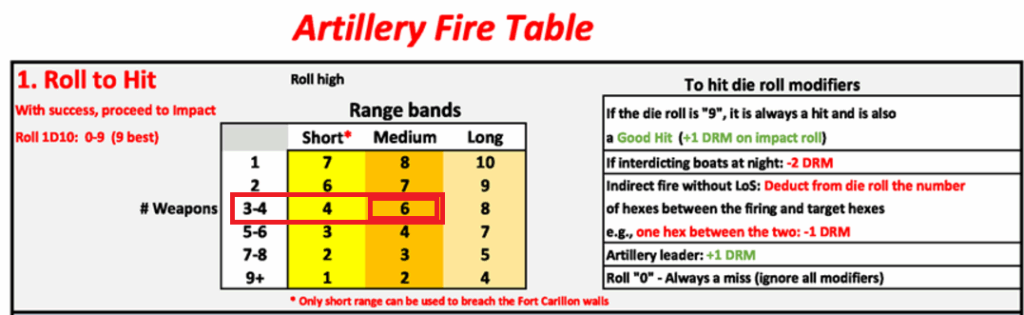
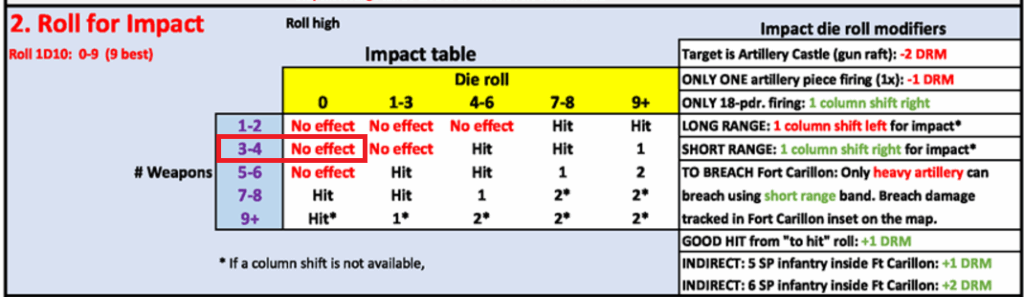
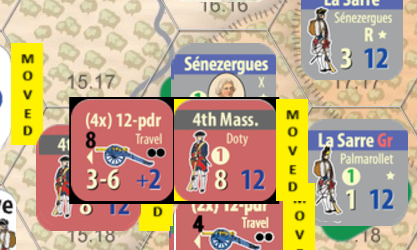
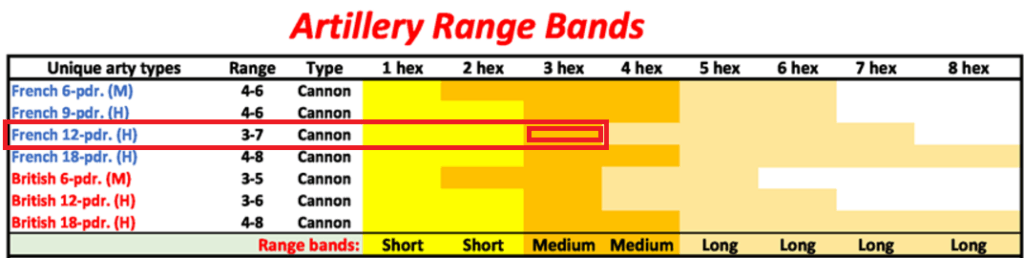
As a brief refresher on the artillery mechanism: during the defensive artillery fire segment, four French 12-pounders bombarded the British on the opposite side of the lake. The initial roll was a 6 (+1), resulting in a “hit,” but the subsequent impact roll was a 0, causing no effect.

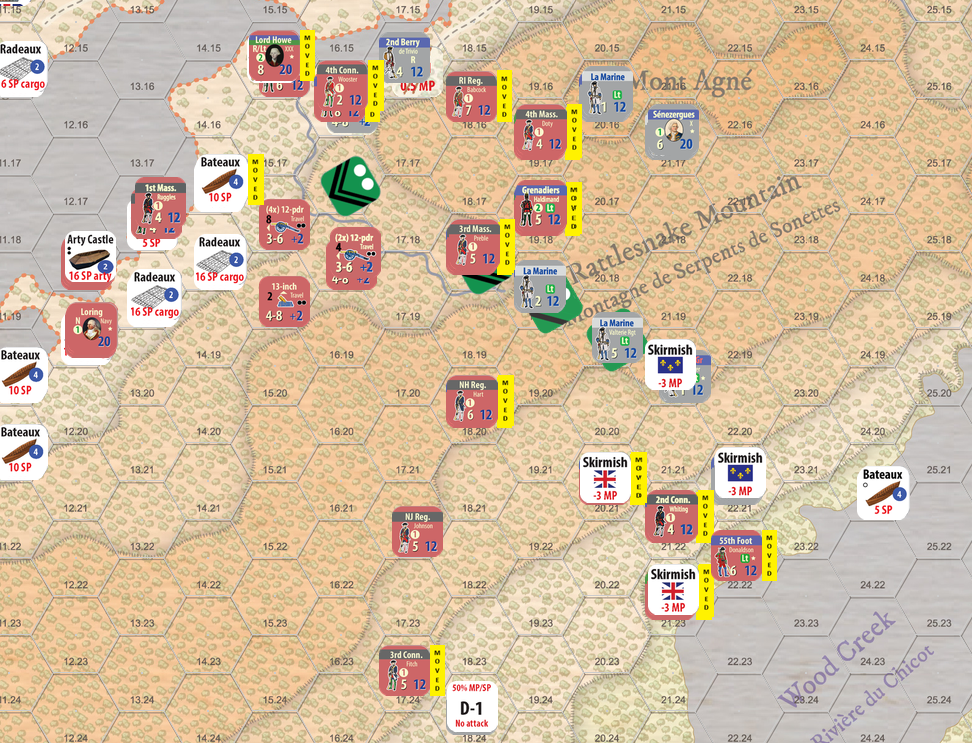
The French 12-pounders were three hexes away, placing them at medium range.

With four guns firing at medium range and an artillery leader providing a bonus, scoring a hit was fairly comfortable. However, the impact roll failed. A few men were wounded and some horses bolted, but in game terms it simply wasn’t enough to matter.

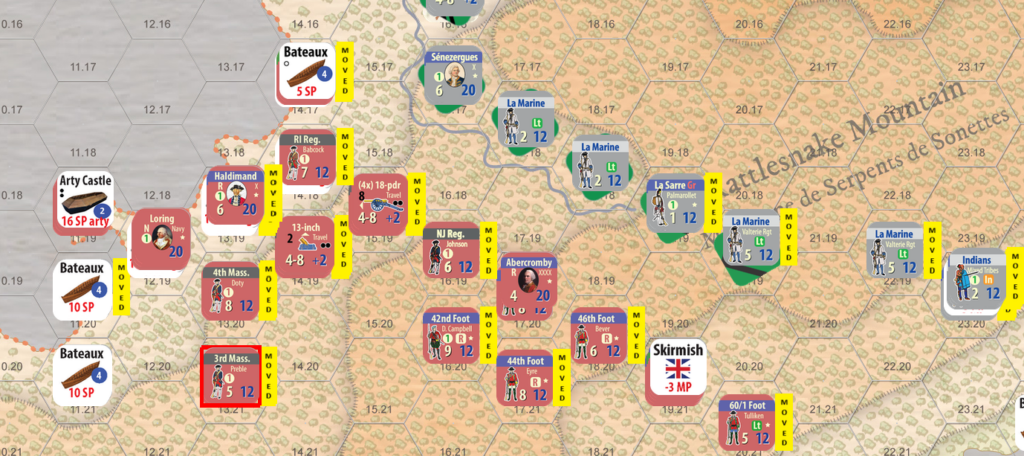
The few British units stranded on the “wrong” (western) side of the lake, facing the main French line, maintained a strong presence to deter the French from shifting troops to the eastern shore. Meanwhile, all available British units continued pouring through the gap in the line.

Starting combat from the bottom of the screen, the 3rd Connecticut brushed aside the demoralized Indian units, killing 100 of them. The next French group pulled back in a skirmish retreat. After a “small rearrangement” of British and Provincial units, I attacked the 300 men holding the line behind the fortifications. They were forced back, and no additional casualties were suffered by either side.

A risky uphill attack against troops holding Mont Agné went poorly. After losing 100 Massachusetts troops, the demoralized survivors were forced to pull back.

An Artillery Castle attempted to push forward along the lakeshore to provide support, but French 12-pounders interdicted the move and forced it back. Though rattled by cannon fire, the wooden armor prevented any serious damage. On land, Lord Howe arrived to lead the 44th in an attack against the 2nd Battalion of the Berry Regiment, inflicting a 1 SP loss and forcing the French to retreat in disruption. This marked the first loss suffered by the French continental regulars.

The only attack on the western side went disastrously. Despite the leadership of John Stark, British troops lost 300 men without inflicting any losses in return – Langy / de Langis held his line. The British casualties are becoming unbearable.

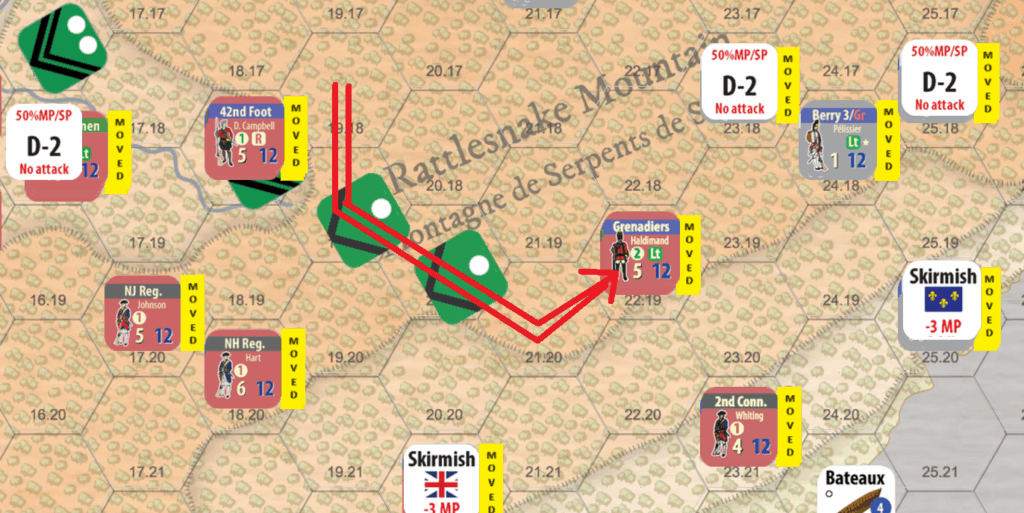
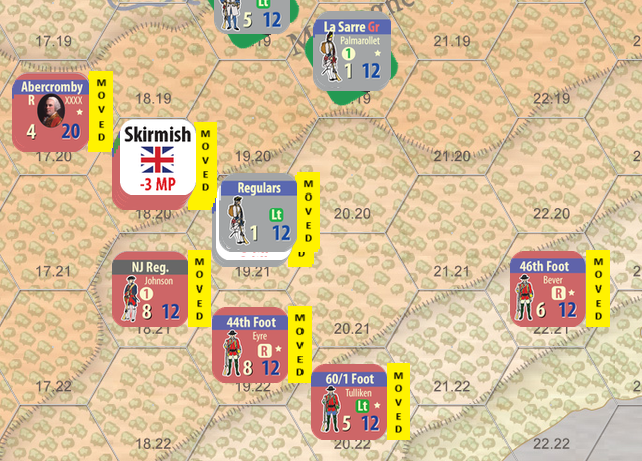
Continuing the initial breakthrough—very ahistorically—Colonel Gage personally led the grenadiers and went on a remarkable run, clearing French units from their positions. Emboldened by this success, his troops pressed on, sweeping away both a strong 6 SP stack and a weaker force guarding the end of the defensive line.

The French line is completely shattered.

1758 Fort Carillon – Vassal Tutorial – Afternoon of July 7th

(After a four-month break from the project, I am now resuming work on it.!)

As the morning action waned, it became clear that the situation was still undecided. Half of the French line on the eastern side of the lake had been cleared, but the British could not really exploit the breakthrough. A French counter-attack was in preparation.

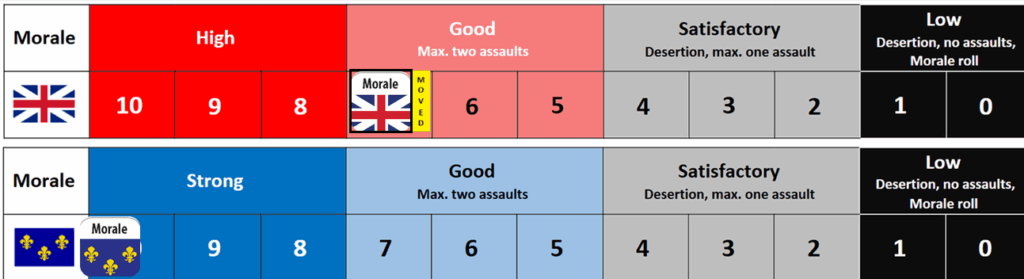
The British gained two Morale points from the assault objective and this brought them back to “Good”. They had already been down to “Satisfactory” which would further limit their actions in the future. This is a combined measure for both the supreme leader’s and the troops’ morale. Once it remains at “Satisfactory” or “Low”, Provincials and Indians start deserting. Also, all disruption (friend and foe) is reduced by 1 at the end of each Phase. The Vassal module has button to do this automatically, so there is no need to go through stacks looking for the markers. Just don’t click it twice in a row 🙂

Injuns!

Having been strengthened by friendly Indians earlier, the French send out a patrol to harass the enemy. Behind the British lines, rattled Provincial units were recovering from the failed attacks, but there was a “hole” in the line that was exploited by 200 Indians. They used the Forced March mode to gain the required extra movement points to put two stacks of disrupted Provincials in their ZoC. This triggers the “Panic disrupted enemy” rule that can devastate its subjects. A total of four separate units have to now make a panic check!

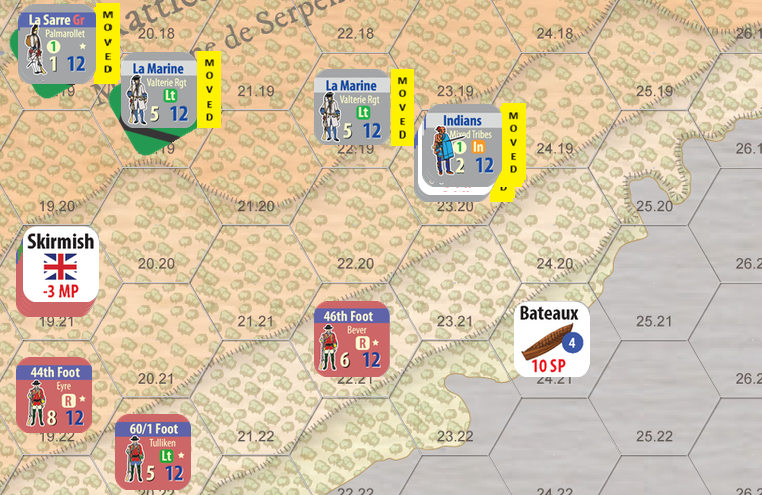
The Indians had to go around the British Skirmish ZoC to reach their targets.

I had to roll a die for each unit separately, and the results were massively disappointing! Three attempts failed and only one resulted in a step loss and a retreat. One Bateaumen unit suffered 1 SP and pulled back three hexes. The others remain in place. This is devastating as the Indians must now engage the remaining units with their strength halved, in normal combat. I am going to go with this for now although I have considered allowing the Indians to move 16 MP by default – and suffer halving the strength. It is a change I will likely make soon, but now I just follow the current rules and data.

There is no defensive support as all British units are Disrupted and all participants are halved. With low odds, it is likely the Indians have to retreat and they will first go against the weaker stack with 5 SP New Jersey Regiment. The unit bonuses give +2 DRM for the Indians, so this could be interesting after all.

The roll is a 1 and with the DRMs 3. Odds being 2:3 the result -1D*. They lose 1 SP, retreat and become disrupted. This was a dismal failure – I expected a devastating strike against the battle-worn units. Indian losses are not recorded, so they just flip over.

I only brought some French back to the lines, because they would have to engage still-strong British troops, except where the Highlanders had breached the line. 2nd Berry stays two hexes away from the enemy and does not try to take the artillery back from the British – the chances are are quite slim.

Led by Sénezergues, the Canadians made a counter-attack with the hope of pushing the Black Watch regiment back.

With 10 SP against 7 SP, the odds are 1:1, and the British have one more bonus than the French. This proves decisive. Both sides take a one-step loss, but the Canadians have to retreat. The system is designed so that when two evenly matched forces meet, the defender has the upper hand. These are not field battles, where other factors like leadership, morale, or fatigue would weigh heavily (they do matter, but the starting point is not even).

In the next post we will see, if the British can continue their push towards the French, as they have taken significant casualties so far.

Planning the next BWC con

Around the summer of 2024 I had yet another idea (amongst the many other ideas), this time to start a game con around the Baltic Sea. Finland, Sweden, Poland, Denmark, Germany, etc. all have wargamers and it would be really cool to have a rotating game meeting in various countries. I had never done anything like this before and frankly, I was not well-connected with gamers, designers, retailers, or publishers in the industry. In any case, in September 2024 we had the first Baltic Wargaming Convention at a public library in Espoo, Finland. It was a zero budget effort on my behalf.

Perhaps 30 people attended, not great but not bad either! The greatest thing was to meet other gamers, and the Three Crowns Games guys, Stefan & Jan, had come all the way from Sweden to attend! My Polish team had to cancel due to a personal emergency, but we’ll try another time.

The 2024 event was described in our Finnish blog Huoltoreitti (“Supply Route”). Use the browser’s translate feature to get it in your preferred language. We were also planning a follow-up event in 2025, but things didn’t work out this time.

I was pondering my options and didn’t fancy another low-key event. It’s gotta be good, especially after visiting the Swedish Friendly Fire twice in 2025. I knew that to enjoy this most, it has to be something different and unique. I have written about my experience in Sweden: FF XVI in February and FF XVII in October (you’ll have to translate the second one, too).

Image by Michal Pise.

Sveaborg – The Gibraltar of the Baltic

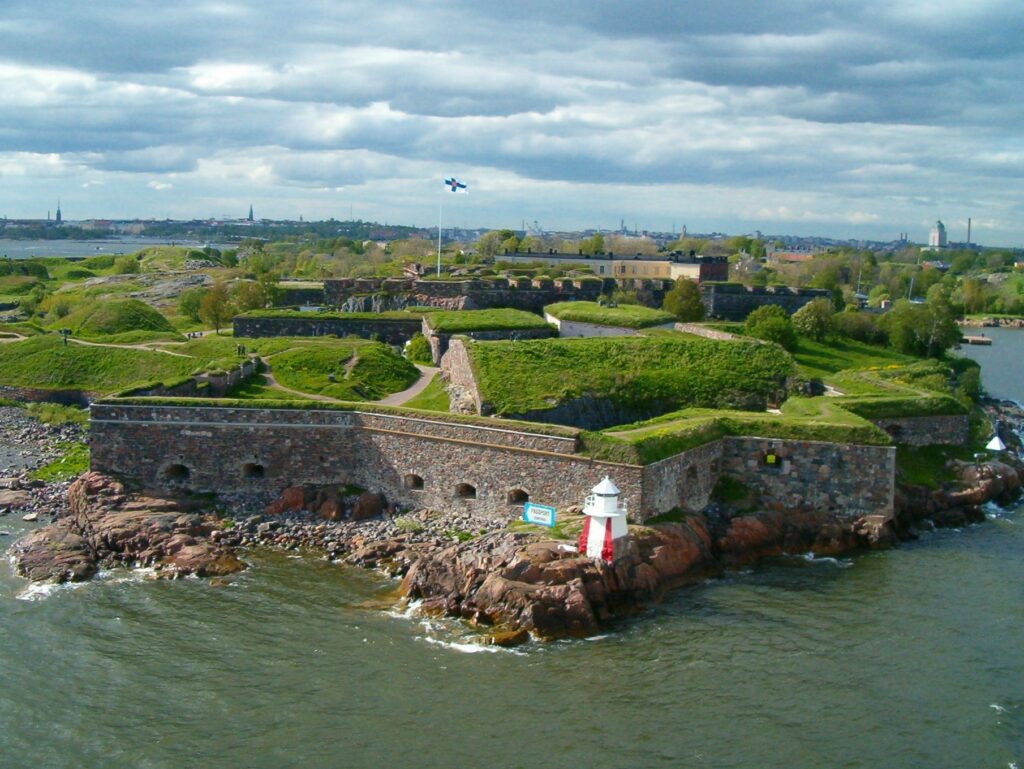
What would be the coolest place to play wargames in Finland? Sveaborg, Suomenlinna! That one gem that makes Helsinki to compete with places like Stockholm or St. Petersburg. Finland has always been the backwater of the Swedish empire, so this is not the Old Town / Gamla Stan of Stockholm (if you know what I mean). But we have the greatest fortress in all of Baltic Sea 🙂

Now all other options were off the table. I started to check out what we have available at Sveaborg and quickly realized there are no free meals. For a weekend event, everything is four-digit euros. The available spaces are really cool, though – you could, for example, rent a former powder magazine, but I ruled that out because it is a bit of a walk to get to.

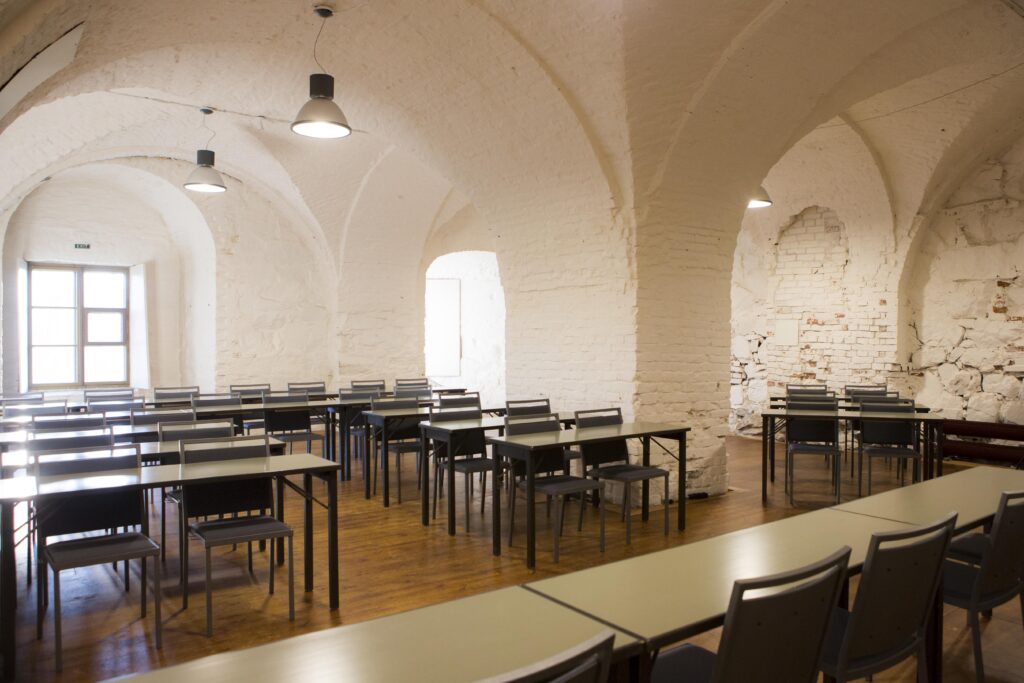
This is where Pajasali Hall comes to play. It is located a very short walk from the main pier where the Helsinki public transport ferry arrives. You have tables for more than 50 people and also a separate meeting room with a single large table – you can either play a big multiplayer game for several days or just have like 3-4 separate games going on. The only supermarket is also nearby, along with several cafes, etc. A Perfect Location.

In short: April 18 & 19 (Sat+Sun). Cool projects and their designers. A third day (Friday) will be added, if I can secure the funds.

Playtesting – Fall 2025

As I am taking a short break from the Fort Carillon project before what I really hope is the final stretch, I have been testing a few game projects amongst other things.

GNWB: Napue 1714

Great Northern War Battles is a system under development. I have talked about this previously (Helsingborg 1710) – the system is quite detailed. Based on that test last February, I got interested in taking a look at using the system to model some of the battles that took place in Finland during the Great Northern War. The Battle of Napue (or Storkyro) was the final, decisive battle before Sweden pulled out of Finland and the time of terror known as the Great Wrath started. This battle was smaller than the other two scenarios in the system, Poltava and Helsingborg.

Roger, the developer of the system, took an interest as not only this would the first scenario not designed by him but also one that had a lot less moving parts and could serve as an introductory battle to learn the system. I have an interest, because it’s my country’s history and something that I have previously overlooked due to WW2 and other topics.

The opening moves. The historical scenario begins as the Russian commander, Golitsyn, wanted to take the initiative in the battle field chosen by the defending general, Armfelt.

We set up the game for the first time – I had only done some very basic testing so far. We had to iron out a handful of small issues and wrote out the first orders. The Russians tried to outflank the Swedish army which had to turn to face the threat against their left flank.

The Russians are approaching. White-blue-green small counters denote the target hexes where troops are heading.

With the system designer next to me, the game progressed smoothly. We tried to replay the historical outcome by timing the actions as we had understood from the sources available. The Swedes (or really Finns) hit the Russian left hard and broke through. Having taken heavy casualties, some Russians started to flee. Next, the Swedish army engaged the main Russian line while trying to capitalize on the stated breakthrough. It almost worked, just like in the real life. The Swedish army simply ran out of men.

The center of both armies have engaged each other.

As the cossacks ravaged the Swedish baggage train, a bloody fight took place on the fields of Napue.

Casualties are tracked in 33-man increments.

Kursk in Finland 1944 – Operation Tali-Ihantala

This is another project I have been testing recently. The Battle of Tali-Ihantala was the deciding engagement that finally convinced Stalin that the cost of beating Finland is not worth the effort. Tali and Ihantala were two small towns in Karelia, now part of Russia, and the Red Army continued its offensive after capturing Vyborg/Viipuri, the second largest city in Finland.

Eventually this will be available via Wargame Vault and published by Firefight Games.

1758 Fort Carillon – Vassal Tutorial – Morning of July 7th (part 2)

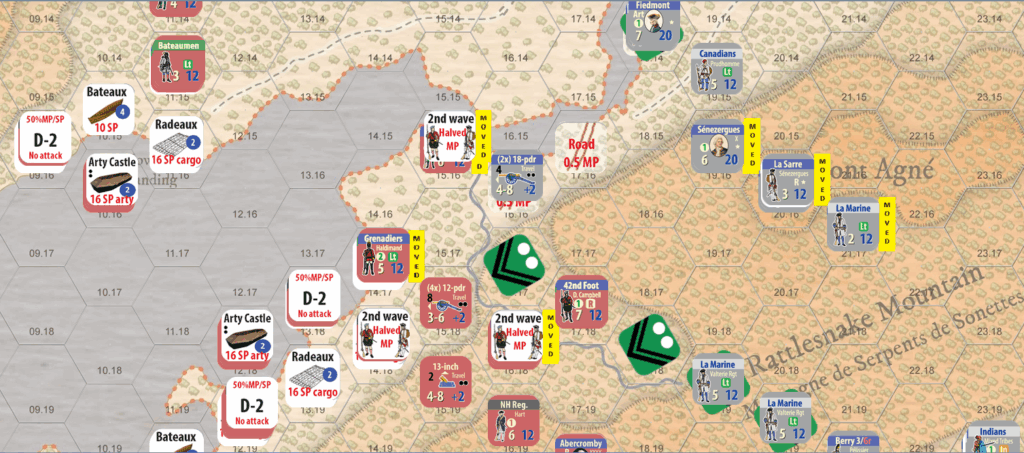
Next comes the assault. Two stacks go against a combined 3 SP strong Grenadier & Canadian defense behind a level two redoubt. The British have artillery which will fire first (technically artillery fire is resolved after all movement has been completed, but it makes no difference in this case). Six heavy guns had been brought up to bombard the French along with a single heavy 13-inch mortar. This is the main firepower of the British army in the whole area of operation. One small mistake I made was to use both of my artillery leaders with the Artillery Castles and only leave the naval commander to support unloading the artillery. This deprived me of +1 DRM bonus here…

I need to roll 3 or higher to hit the fortification with some effect. And I rolled a 3! Phew! Next roll for the impact – with the heavies only, it’s a guaranteed “hit” due to a column shift right (meaning has an effect on the target). The result is a 7 destroying the redoubt completely – big guns can be very effective! No other damage is inflicted.

Next, the massive mortar goes into action. It fires shells weighing 200 pounds, or 90 kilos!

Firing from two hexes away, it gets a -1 to hit and ends up just missing the target.

17 SP are going against 3 SP – that is a 5:1 odds. Even the redoubt would only have taken it down to 3:1. I need to resolve each stack separately using the same odds. As all assaulting troops are now regular infantry, none of them are halved. Before commencing, I have to pass the leader roll and it might be close because Gage is my leader and he isn’t that good. And he fails! There goes the better odds, but it might still work out with the two good stacks going in.

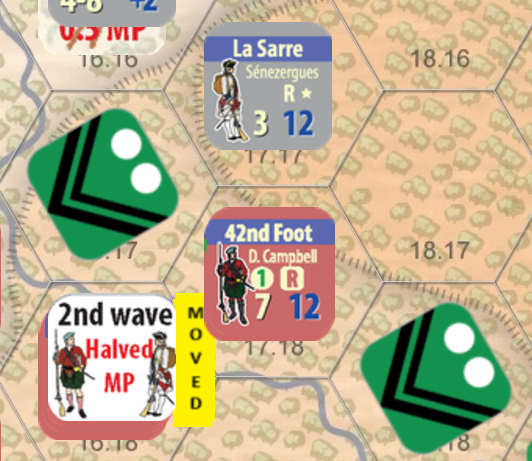
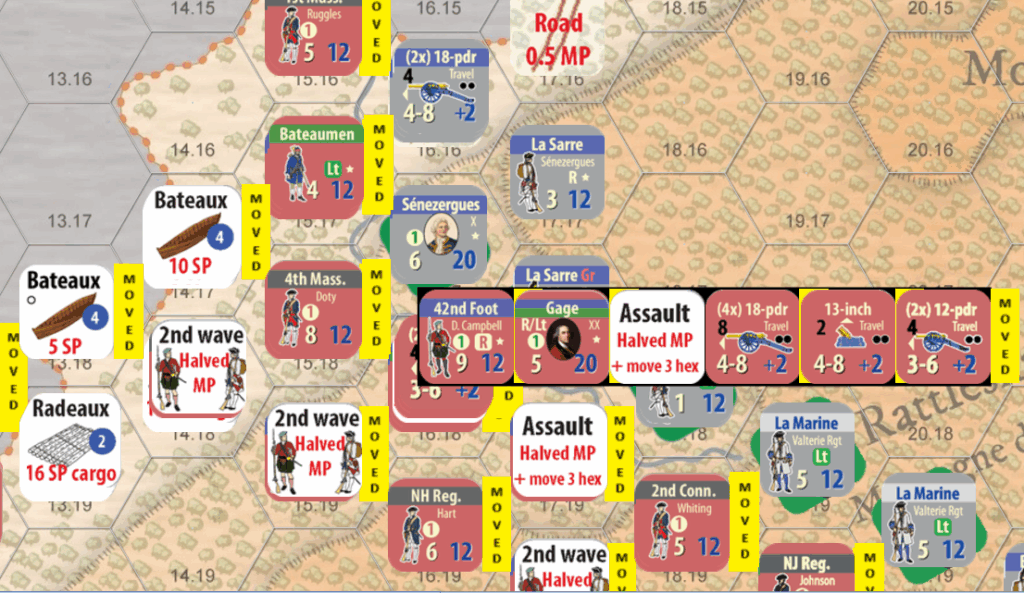
I’ll do the larger attack first. The Black Watch (9SP and +1 DRM) attack across a stream (-1 DRM) led by Gage (+1). The roll is 6 and net DRMs are +1, making it a 7. Result is a step loss, disruption and retreat for the defenders. Canadians take the loss and both units pull back three hexes. The 42nd Highlanders advance in to the hex in the middle of the enemy line and things are about to get messy here. The other stack stays put. As an assault target is captured, if they can hold on to it till the end of the phase, Morale goes up by 2.

There are three more French hexes with adjacent British units who only have troops on two hexes. The British have to either split one of their stacks to engage all three or accept the fact that one of the enemy stacks is reinforced by the adjacent French troops not involved in combat (albeit adjacent to the British/Provincials units). The latter might be a better option.

I am cautious with Bradstreet. By leaving him behind, there is a smaller possibility of losing him in combat should one of the stacks actually breach into the line. It can get bloody, especially if a weak unit breaks into a mass of enemy troops. They’ll fight till nobody is adjacent and there can be many chances of getting him killed. I don’t want to lose all my key leaders on this one day as the replacement leaders are weaker.

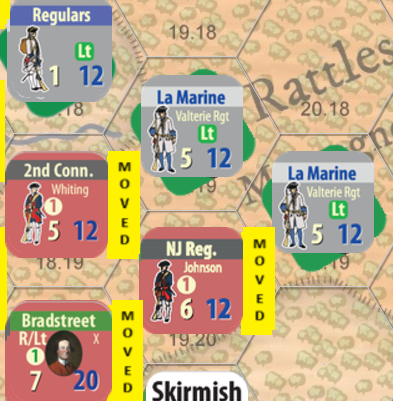
“First” attack goes in with 10 SP Provincials halved to 5 SP (due to the redoubt) against the entrenched 3 SP La Marines and Regulars. 3:2 odds drops two columns down to 2:3. There is -1 DRM for the Provincials (they both are “-1” but these are not added up, but the modifiers just remains at -1), -1 DRM for crossing the stream and +1 for Bradstreet in the background.

Roll is 6, modified down to 5. Result is -1D, actually not too bad 🙂

The last attack here has 10 SP of irregular infantry with -1 DRM attacking the dug in 5 SP La Marines supported by 3 SP from the adjacent hex (half of the SPs on that hex). Irregulars are halved against entrenchments, so ultimately we have 5 SP vs. 8 SP and one more column shift against the attacker. DRMs cancel each other out. This doesn’t look good at all.

The roll is 2 and results in a hefty -2DM*: two step losses, an Army Morale point loss and a leader loss check for Bradstreet. That roll goes bad – it’s a 2 and Bradstreet goes down! With him also goes an additional Morale point and 2 SP of Bateaumen who decide to take off and leave the battlefield (from any Bateaumen unit). It’s a hard choice to have a leader to lead an attack – their DRMs are often crucial for the outcome, but it can come with a heavy price. I removed the 2 Bateaumen (battoemen, … whatever) from those on the other side of the lake.

The Second Wave

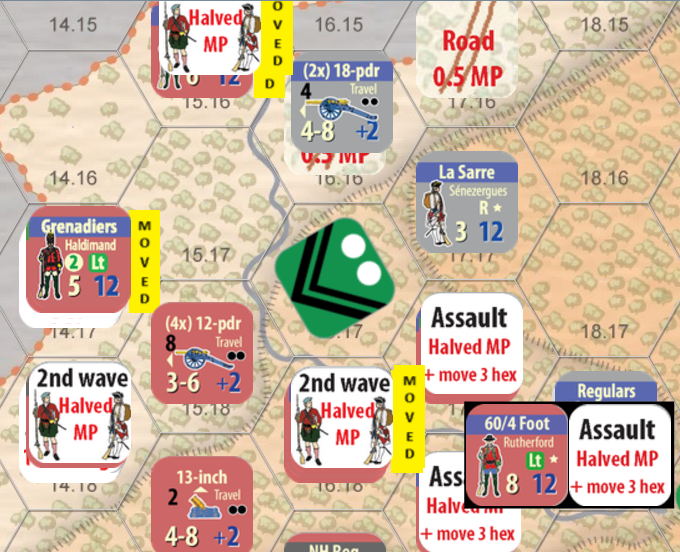
After the first round of combat, I can move my reserves, i.e., the 2nd wave units. I will take some risks and attack Sénezergues and his merry band of Berry-men once more. Although there is rule for max. two attacks against a single hex, that does not include any combat that will be required once a unit has either advanced or retreated into a position where combat is required (being adjacent to the enemy).

Two regiments of regulars move into position to protect the artillery in forward positions. Although they are protected by friendly ZoC, an advance – which would be foolish – by the French could lead to losing some of the heavy guns.

Round #2

In the first round the British achieved two incursions into the French line. The one by the lake is quite interesting and the other one achieved by the Highlanders still hangs in the air – it will be a slugfest for sure. Fighting isn’t over yet and soldiers don’t just sit down once they are inside the enemy positions and start brewing tea. The British are surrounded by hundreds of French and Canadian whose only goal is to kill them all.

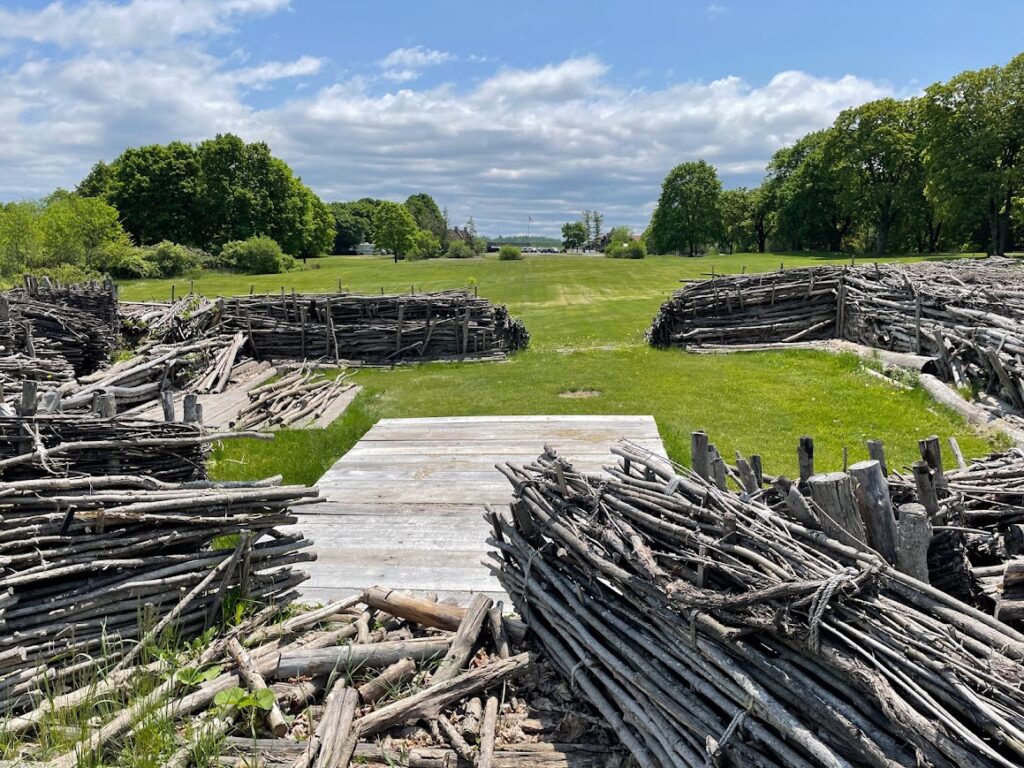
First those Grenadiers and Bateaumen on the shore turn their eyes on Sénezergues and his Berry Regiment. The fortification only protects from three sides – not all around. This was a design decision to balance between x lines of rules (x is not a small number) and the common historical design, as seen below. I actually had this in an early version of the rules and it got messy. You need tons of extra counters to cover various situations which might arise.

10 SP will attack uphill (-1 DRM) comprising of 6 SP of 42nd Regiment (+2) and 4 SP of Bateaumen. 4 SP defend with their leader providing a -1 to the attack. So, odds are 2:1 and no modifiers. Let’s roll the die!

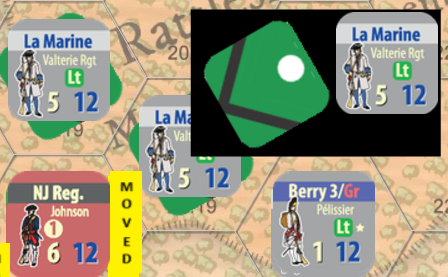
Boom! A Zero!

Result is thus -1DM* – but there is no leader attacking, so we can ignore that. One step loss for the Grenadiers and a retreat plus yet another morale hit… A disappointing result, indeed.

And then I find bugs in my Vassal, again 🙁

Before shutting down to rectify my counter rules in the module, I’ll finish off some combat. Campbell’s Highlanders with then-Colonel Thomas Gage (of Revolution fame) in the lead charge against the Berry: 9 SP (+1 DRM), Gage (+1) vs. 4 SP Berry and Sénezergues (-1). There are no other modifiers and the Scots are coming behind the earthworks.

The result forces the French to retreat, but no casualties are suffered by either side. They are lucky, as the backup unit behind them spares the retreating French from suffering losses from the EZoC – they are able to slip away unharmed.

I decided to not move the Highlanders into the vacated hex as I want them to now switch their attention to the other side of the French line and try to roll it up.

Before they can attack again, the 60th Regiment (4th Bn.) must go first. 8 SP vs. 3 SP, two levels of fortifications (-2 columns), +1 DRM from adjacent Gage and -1 for the stream. Final odds are 1:1 and no modifiers. I should have brought in a small unit to support them…

Roll is 2, so one step loss and disruption. The British losses keep mounting with little progress.

Now the Highlanders can go again. I removed the Assault mode marker, it plays no role anymore. 9 SP against 3 SP is 3:1. As there is a contiguous defensive line, there is no column shifts involved – this action is behind the French lines. It is also the usual +2 DRM for the British (Highlanders and Gage).

And the roll is a 1. Maybe the British should just pull back and drink their tea, and try again tomorrow. Well, they do win this one, although suffer one step loss of 2 SP (being a large unit).

Again I decide to not advance the Highlanders into the hex. After suffering those casualties, it is better to go against the last remaining French unit in the vicinity, 3 SP La Sarre. It was Lt. Col. Étienne-Guillaume de Sénezergues’ own regiment, thus he is listed as the regimental commander on the counter. Those are for historical interest only and play no part in the game.

The odds are 2:1 with a final +1 DRM. Let’s see if the bad luck continues!

I rolled 7 with +1 it becomes 8! Not too bad! However, no casualties are taken by either side but the French have to pull back three hexes. Now this are has been cleared. The question is, will they counter-attack or start pulling back? I think we’re gonna fight, so I shall place the Highlanders accordingly. This means: stay put and don’t get cut off.

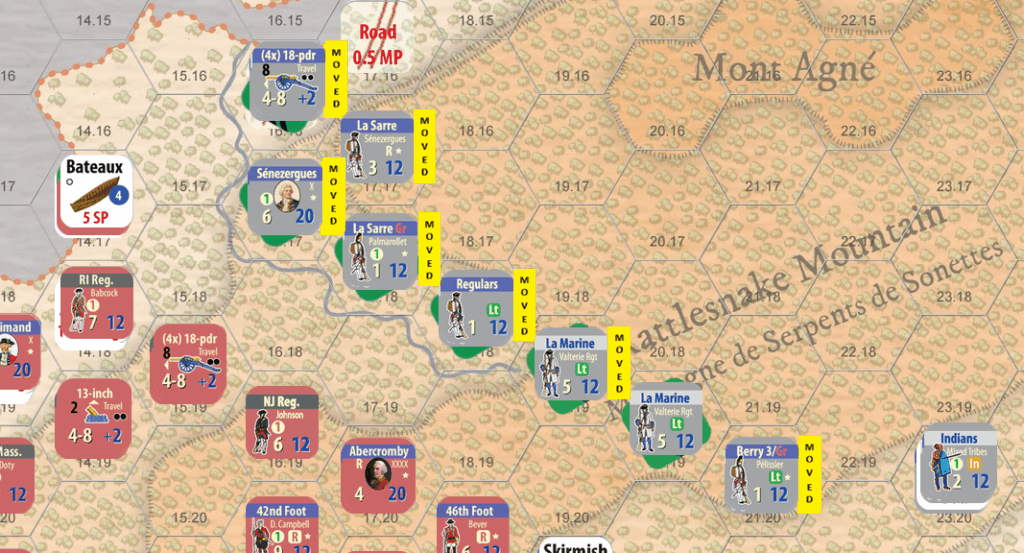
The end result of the British assault is above. Although the line was breached and the French were pushed back, I have to say this can still go either way.

To be continued!

1758 Fort Carillon – Vassal Tutorial – Morning of July 7th

As the sun rises for the big day (in this scenario), the French leaders discuss if their defenses are strong enough. They are confident the combined army of New France is able to stop and push back the red coats along with the provincial regiments crowding in front of them.

The French prepare for battle

A batch of 500 Canadian militia lands in the morning and they are sent forward to beef up the French left. They arrive just in time to see a huge number of enemy troops approaching.

Other French troops are shifted to better positions to eliminate weak spots. If the British break through, they’ll have to fight their way in to defenders’ rear. And that will not be easy and requires bringing the heavy artillery forward.
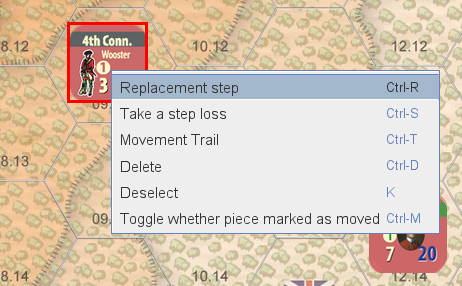
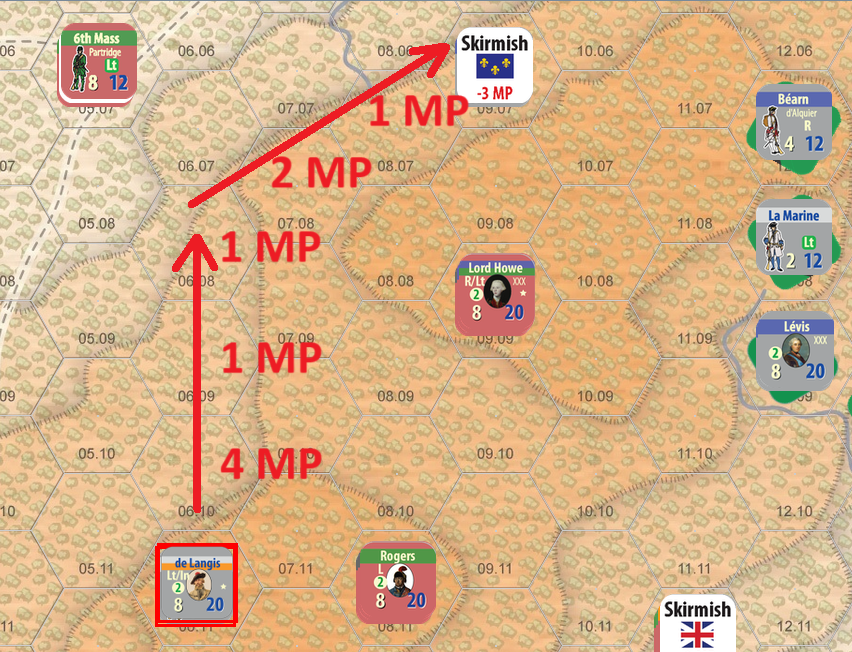
De Langis with his blocking force sneaks back through a gap left by the enemy vanguard and is able to get back to friendly forces. 12 movement points is just enough even in this tough terrain. No need to use Forced March which would lower their fighting ability. Crossing a steep slope takes time, but the rest of the journey was mostly along the side of the mountain. The distance is not great, but this is difficult terrain and I have slowed down the game over time – there was too much mobility in earlier versions.

This concludes the French Movement Action Segment and we get to the British movement next as they prepare the troops for the big day.

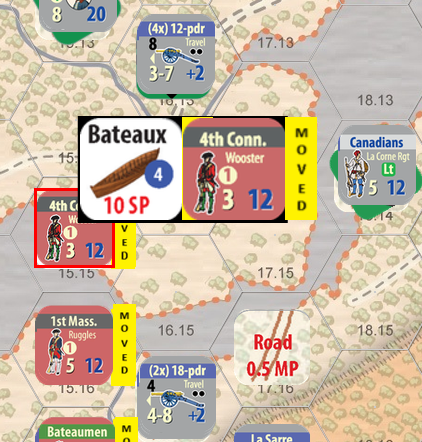
First, two Artillery Castles move into action one by one. As the first one nears the narrows where the French positions are located, some heavy 18-pounder cannons start blasting at this “armored” vessel. This time they miss completely by rolling a zero. Even the available modifier does not help – a zero is a zero. The British vessel continues advancing into the nook – the other French artillery remains silent as they are waiting the first vessel to continue their journey even deeper. The British artillery captain Ord decides not to push his luck and opens fire against the French fortification at point blank range.

With four howitzers and two guns onboard, they succeed gaining a hit. We still have to test for potential damage, so another roll is required. They do not miss and inflict massive damage on the earthworks destroying them completely. A shift right with the short range helped to achieve this. The artillery also takes a step loss reducing the 18-pounders to two pieces. This was a significant achievement, especially as the British ground troops hadn’t started their advance yet. A hole is opened in the French lines!

Artillery losses are not counted in the game – they just lessen the capabilities of the side suffering the loss. The second Artillery Castle also moves forward and in turn is interdicted by the two remaining heavy cannons, but without causing any damage. This time the two other batteries do not wait for a deep excursion and open fire at three hexes range even if it is beyond optimal (which for them is either one or two hexes). They score a hit forcing the vessel to retreat – no other damage was suffered.

Besides moving a lot of British troops and artillery for the assault, I also try to sneak a small Provincial unit through the artillery gauntlet. It’s unlikely they’ll make it, but let’s try!

Cannons anchoring the French left take a shot and hit the bateaux. This Connecticut regiment ends up taking a step loss becoming disrupted and falls back to the departure area.

I decided to not only try to breach the hex where fortification was destroyed, but also another one in the middle of the French line – this is where the assault is now planned. I put two of the strongest British regular units into Assault Mode and moved forward pretty much half the Brutish army.

There were mostly provincials close to the shoreline, so they would have to attack separately. My regular infantry was too far away to be prepared for an assault there – after all, I hadn’t expected to be able to attempt a breakthrough there.

The British troops had been split and this complicates the planning. I had some of my best commanders on the wrong side of the lake, but I take that as they are now in reserve in case I do need to renew my attacks later. There will be heavy casualties, just like in the real battle, when going against a fortified position. I was able to move some units across the lake to enforce the British assault troops. Additionally, some heavy artillery took too long to drag over to the front to support my attacks this turn. They might be available in the afternoon if we still need them.

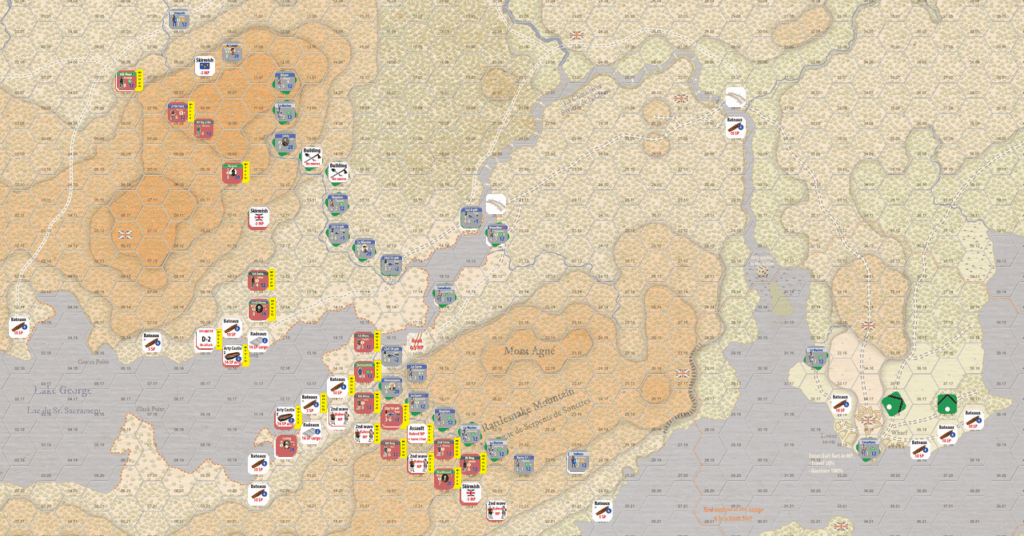
The overall battlefield with a skirmish line on the west side of Lake George (top) and a concentration of the British main army on the eastern side (bottom).

The Battle

Combat consists of one or more “rounds”. The first round is simply all combat after movement is completed – being adjacent to the enemy typically means you must attack. This is the first round. If, after all battles between the forces have been resolved, there are adjacent opposing units resulting from a) advancing or retreating after combat and/or b) reserves, i.e., the 2nd wave units, are brought into action. In this case, adjacent units must now resolve combat. Exceptions to this rule are, for instance, water between the two units (except streams, at least for now) or both sides are entrenched.

I will now start with the British left wing attacking the hex where French entrenchments were destroyed. As I am unable to use the Assault, which actually could have been useful here, I have to make two separate attacks. As most of the units there used water movement, they cannot participate in an assault.

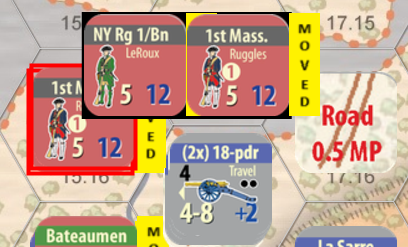
The provincials attack first – DRMs are against them, but never know! -1 for the 1st Mass, -1 for crossing a stream, -1 for Sénezergues leading the French. They get +1 for Haldimand on the adjacent hex. The French decide to save their artillery for the other stack that has the British Grenadier battalion.

And they roll a zero… that is a “challenging” result. They take two step losses + disruption, a morale loss for the whole army, and also a leader hit check.

The British morale drops to Good. It’s not that bad really, but going down on the scale is not good news. It’s a race to the bottom and the “winner” loses.

Boom! Haldimand does not pass the leader hit check and is dead. There goes a bonus I was planning to use in the next attack.

Now the French fire their guns against the stronger British stack. Target is of course Grenadiers. Fiedmont – the French artillery officer provides +1 DRM. It’s an 8, modified to 9 – a definite hit. But they only roll a 2 and basically do not hit enough enemies to make a difference.

Another attack follows by the British Grenadiers supported by Bateaumen. No leader support is available as we lost Haldimand, but adding up the DRMs they all cancel each other out. +2 for Grenadiers against -1 for stream and -1 for busybody Sénezergues.

The odds are 2:1 and the roll was an 8 (not too bad, really!). No casualties on either side, but the French have to retreat and their cannons are captured by the British.

My sacrificial lamb is the 4th Mass who has to attack the well-entrenched Berry Regiment’s 2nd Battalion so they cannot support any of the surrounding engagements. The Mass troops have to attack across the stream, uphill, against a redoubt led by one of the best commanders in the French army. The raw odds are 2:1 but there will be three column shifts against… final odds are 2:3 and DRMs are -3. Looking bad!

Rolled a 3. With -3 it becomes a zero and we get yet another -2DM* result. Two step losses, a morale loss and a leader loss check. The brave Massachusetts regiment loses half of its strength (both of their step losses were actually 2 SPs),

I will have to continue this in the next post – soon!

1758 Fort Carillon – Vassal Tutorial – Maintenance Segment

Writing this post was delayed as I got involved in another game project and did some OOB research for it. Also, some of the Vassal module updates wiped out many counters from the save file. I lost e.g., all casualties, so had to rebuild the losses table based on the previous posts. It should be close enough to continue.

In the Maintenance Segment of the Morning Action Phase, during the “council of war”, the player(s) may commit to one of more assaults. These are coordinated attacks from two hexes against one. Committing to one immediately costs one Morale point which you’ll gain back double if the assaulted hex is captured by the end of the phase. There is no need to decide which hexes will be assaulted at this time. Because today is a big day, my British will commit to two assaults and thus it costs two points of Morale. Before that I rolled for improving the morale – now only for the British, because the French morale was at max. Later in the game, this could have some significance as the number of available assaults also depends on the level of morale.

The British supreme commander, Abercromby, has a leader rating of 4 (scale 1-9). I have to roll this or lower to improve the morale. This way, leaders with a high rating have a good probability to increase army morale. I rolled a 7, so no change. Abercromby really wasn’t the heart of the army, was he?

Any replacements are also received during the Maintenance Segment. These are previously taken casualties that trickle back to the units. For every 4 SPs lost of either regular or irregular type, one of that type comes back. I’ll just add 1 SP to one of the provincials. The remaining three SP go into the permanent losses area, where they will lower the morale by one for every 6 SP lost.

Other things I have to are to remove the Interdict markers and land some British supply. The latter does not play a significant part in the game and might feel redundant, but it did play a major role in any military campaign. In my speed play, I’ll ignore this part – it’s mainly there to tie up some troops to land the barrels of food and munition. There are some other small bonuses, but that is not relevant right now.

This concludes my Maintenance Segment and I move to the Morning next.

1758 Fort Carillon – Vassal Tutorial – Night of July 6th

At the end of the British afternoon phase, I reduce *all* units’ – both friendly and foe – disruption by one step. It’s a simple way to ensure disrupted units are at the disrupted state once during the opponent’s action segment. There is no rolling for leaders to bring them back – in this game they will self-heal.

At night, all movement is halved. Although it was tempting to create some sort of “getting lost” mechanism, I decided against it. There are enough rules already.

The British regulars and provincials’ combat factors are also halved. What I haven’t still implemented is a first day French combat bonus – it’s a rare missing feature. Mostly I concentrate on removing and streamlining the features. So, the night might provide an opportunity for the French to attack a stack or two.

As the French army is still outnumbered 3:1, they stay quietly in their breastworks and try to beef them up as much as possible. The line will be bypassed, so it might not even face a determined British attack. That we will see in the morning. Only small adjustments are made by moving some more men to both ends of the line.

A bigger boost was gained by the reinforcements arriving during the night, numbering a staggering 1700 men (half of the historical French army at Carillon). It is quite apparent this scenario is very different from what actually happened there in 1758. Who knows what kind of battle would have taken place, had Vaudreuil approved Montcalm’s request to concentrate the army in one place.

The French blocked the British from exploiting a gap on their left by landing some of the reinforcements at the foot of the Montagne de Serpents de Sonettes (Rattlesnake Mountain).

1000 of the reinforcements were taken as far as they could travel at night. Arriving by boat, they could first move up to the waterfalls on La Chute River from where they continued along the rudimentary Portage road. This is a significant force and might ultimately prevent the British from making any significant gains in the area. These units now protect the tip of Lake George, where some French artillery and the pontoon bridge are located.

1000 Canadian reinforcements arrived at night to become the main reserve for the French. From their location, they can move to intercept any incursions into the French rear.

In the morning we’ll see how the British try to deal with this formidable army. In any case, forcing it will be an expensive effort and heavy casualties are something that will hit the morale of the army.

The British army decided to move a lot of the troops that had landed on the western shore across the lake to the eastern side. Some guns and mortars were slowly hauled uphill to support the upcoming assault.

The British army prepares its positions during the night. 7th of July will be a big day.

Some small action ended up with light casualties: 2 SP for the British and the French lost a Grenadier company as they didn’t voluntarily yield to the force of 1000 Massachusetts light infantry…

In the next post, I’ll take a brief look at the Maintenance Phase before we get down to business.

1758 Fort Carillon – Vassal Tutorial – Afternoon of July 6th

Moving to the second phase, afternoon, the French decide to take no aggressive action. The British have split their forces and this could be a golden opportunity to hit them hard. However, looking at the strong enemy forces facing the French, perhaps it is just better to wait behind the earthworks and see what the enemy plan is. The French only strengthen their patrols to delay any British advance and also enforce the two artillery batteries protecting the fort with 2 SP Canadians each.
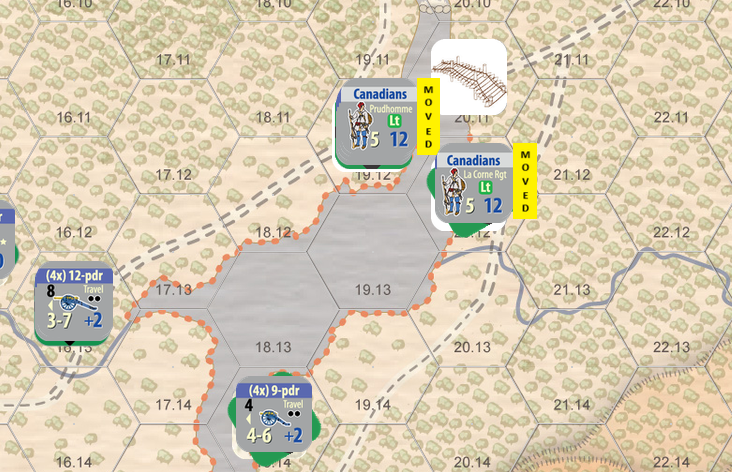
We move now to the British Action Segment on the afternoon and its going to be a busy one. They can’t make any assaults (i.e., two stacks attacking a single hex), as those need to be preplanned in the Maintenance Segment and there hasn’t been one yet.

So, as the British, what shall we do? We had landed the main army on the bottom part of the map (east), but have quite a few irregular troops and key leaders on the opposite shore. The day is fading fast, so we won’t have a lot of combat coming up – more positioning the troops for a push in the morning. There is no point trying to force the French line before sufficient forces are available. Obviously, this scenario is very different from the historical one.

The first thing to do is to land that artillery as it will take some time to get them off the rafts* and start hauling towards the enemy. Everything is now in place, both the rafts with the artillery and the men required to unload. However, I can only commence the work during the night Action Phase which follows the afternoon.
* The players must commit troops to haul artillery around. Loading or unloading arty requires a lot of manpower. The large cannons and mortars weighted several tons each and they surely don’t just hop ashore by themselves! The “road”, i.e., the portage, was not really a road, but a soft and muddy path after the heavy rains in early summer of 1758.

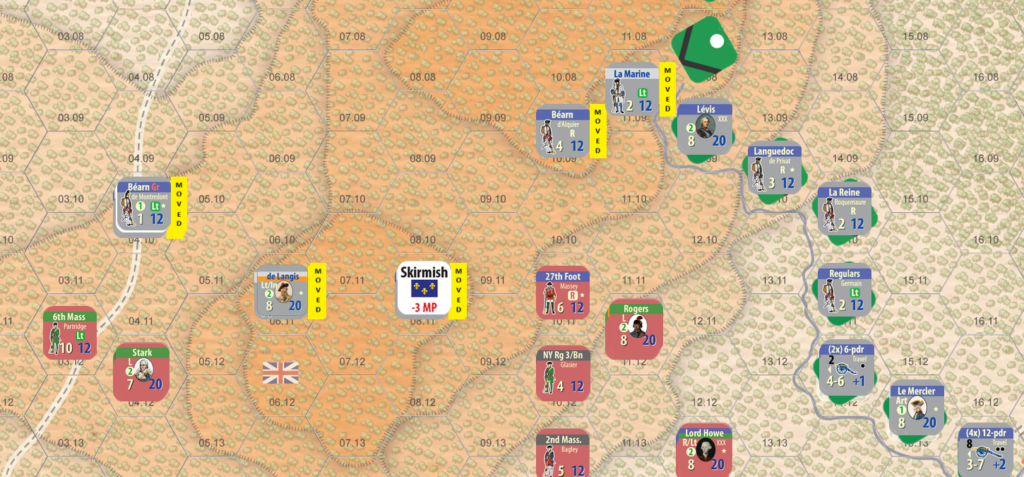
Next, I put some light infantry into Skirmish mode and engage the French skirmishers. They cannot ambush now as the two opposing skirmishers “cancel each other out” and decide to stand and fight. Covered by a ZoC I am able to move additional units there so I can hit them at least twice (which is the normal maximum of attacks per hex). More attacks can only take place if e.g., a unit must retreat next to it (and is thus mandated to attack).

The remainder of the segment is just moving the British into better positions.

The British engage the French forward patrols

We’ll have a handful of engagements in this segment – namely trying to push the French skirmishers back.

Let’s start with Stark and the 10th Mass. light regiment (10 SP – ~1000 men) on the left engaging 300 Indians and Grenadiers. Ten against three is 3:1 and Stark provides +2 DRM while the opposition has -1 DRM for this skirmish – net +1 DRM. I rolled a “5” and with the DRM, it ends up being a “NE / R” result, i.e., the attacker has no effect and the defender has to retreat (three hexes). The French group simply retreats along the path to continue being a road block.

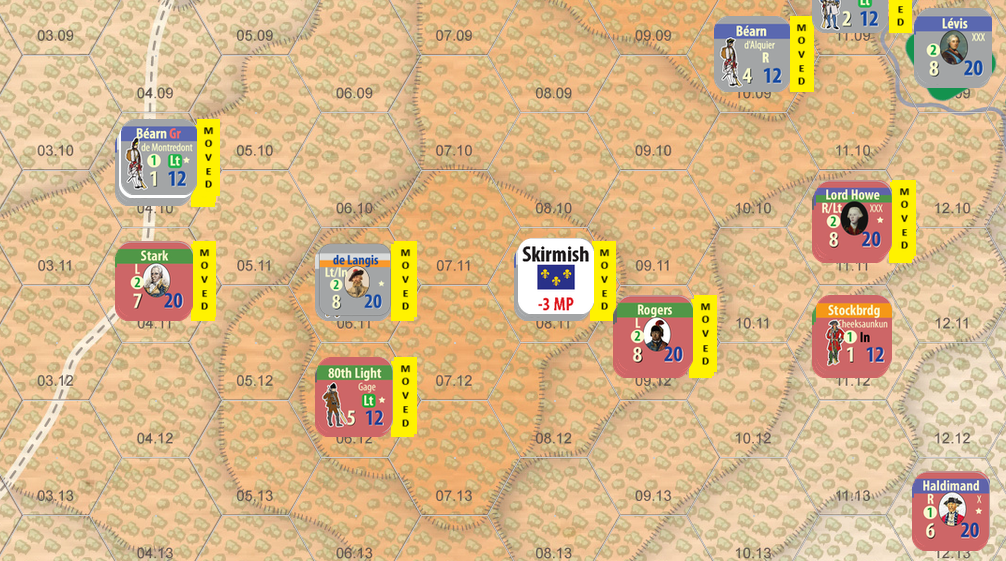
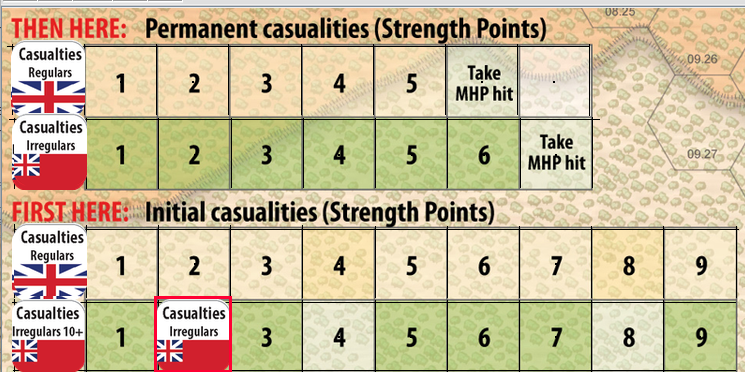
Next, we have 5 SP (-1) provincials with 5 SP 80th Light Infantry going against 4 SP Canadians, but de Langis (“Langy”) is a great leader and gives, in this situation, -2 DRM for the engagement. And it’s another “5” than turns into a “2” because of -2 DRM from the French leader and -1 from the provincials. The result is a “-1D* / NE” meaning the British units take one step loss. I will allocate this to the provincials, because there is no positive DRM provided by any unit allowing me to choose who takes it. In this case, the step loss is just 1 SP (with larger units, it can also be 2 SP). They will be Disrupted and must retreat three hexes. There was no leader on the attacker’s side, thus the asterisk is ignored (leader hit check). Once I moved the counters back, I reduced the provincial regiment by one step and added that 1 SP to the Initial casualties track (the irregulars’ initial casualties are now 2 SP). In the game, it is important to separate step losses and SPs lost – they do not go hand in hand.

Moving to the third skirmish where we have 9 SP provincials attacking uphill against 2 SP (an Indian and a regular unit). This time Rogers is leading and thus provides a significant boost to the attackers (+2 DRM), going uphill negates part of that (-1) and also the Indian unit has a bonus (+1): the net is no DRMs for either side. These provincials do not have any negative modifiers (a NY and a Mass regiment).

Now I roll a “6” and this makes it a “NE / -1” – defender loses, takes a step loss and must retreat those three hexes. 1 SP Indian unit is destroyed (they provided a positive DRM for the defender and must take the first step loss) and I’d say that is a grave loss for the French. The Indians carry more than their weight in SP – they have some special abilities.

The last battle in this Action Segment is on the eastern side of the lake where I have three British stacks each at 8 SP adjacent to the French stack with 4 SP. I can make up to two attacks against a single hex, so let’s start with the NJ Regiment (-1) to soften up the defenders. Although there is no British leader stacked, Gage is on the adjacent stack and will provide a +1 DRM to negate the -1 of the provincials (leaders have a one hex radius). The French have no modifiers (the grenadiers are from the Berry Regiment which was untried and had little combat experience).

This time, I roll a “4” and with 2:1 odds it means the attack fails and the provincials lose 1 step and must retreat (and I spotted an error in my table!!!). As the NJ Regiment was a large one with 8 SP, one step loss is actually 2 SP which I will add to the Initial losses. With 4 irregular SPs lost, 1 SP is eligible to return to combat in the next Maintenance Segment.

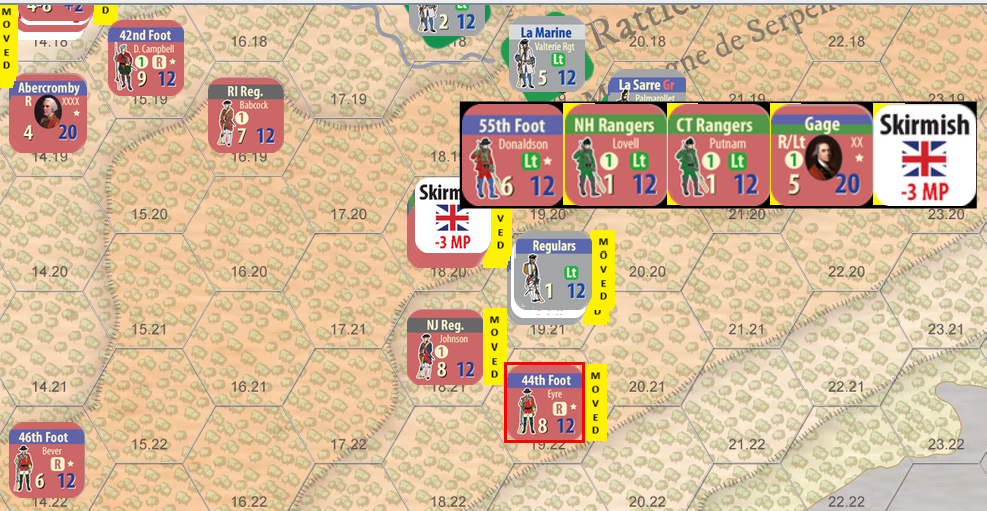
The second attack against the same hex is by the 55th Regiment of Foot accompanied by two Ranger companies (NH and CT). The whole group is lead by Gage who goes into his 2nd attack of the afternoon. The French have no bonuses and the British get a +1 DRM from Gage. The odds are the same 2:1. Attacking downhill has no effect one way or the other.

I roll a “4” (all rolls within Vassal have been now between 4 and 6!). Add +1 DRM and it is a “5” – although the Rangers do have a bonus, they are not at least 50% of the SPs attacking and thus do not carry enough weight in the battle.

The result forces the French to retreat. The victorious British advance one hex.

One thing I apparently forgot is to bring back the units that had retreated off-map earlier. As I write this in small chunks I overlook a thing or two (I am on vacation!). I’ll fix that now and land those troops along the shores. This basically concludes the daylight segments of the first day and night will follow with the subsequent Maintenance Segment.

I will continue the game in the next post in about a week or so.