In the previous post, I did not complete the first British turn fully – the landing of the main army was only getting started.
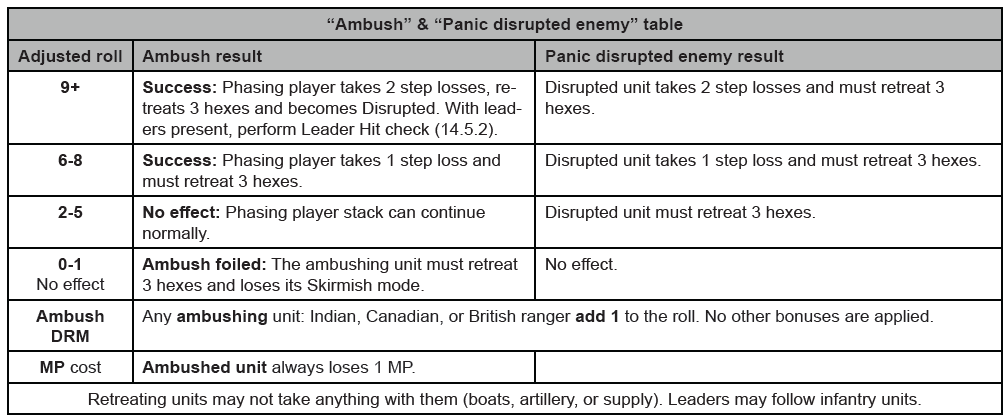
One Massachusetts regiment was ambushed after landing and retreated off-map. But the British now follow-up with another regiment landing in the same place – they now know there are French around and cannot be ambushed by the same unit again. If there was another unit in Skirmish mode, that could attempt the ambush, but it’s too far away.
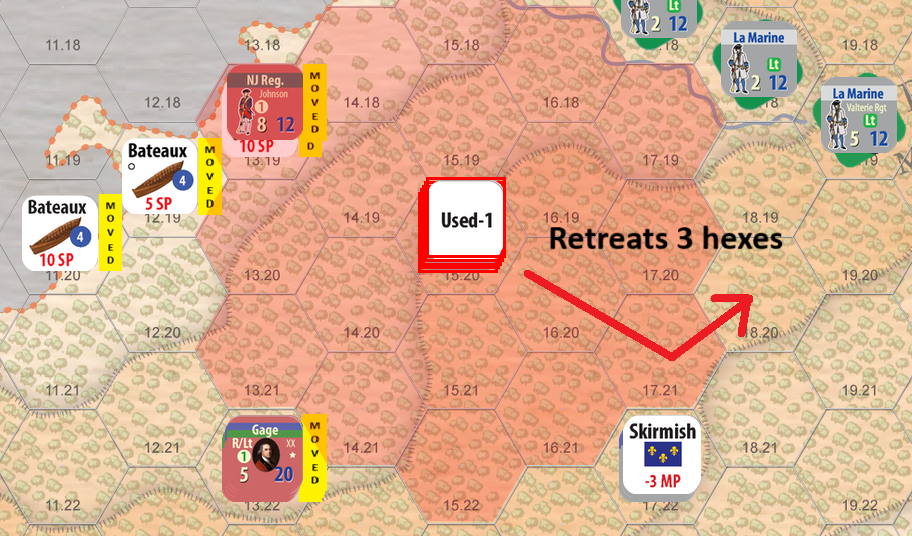
The New Jersey Regiment lands into the ZoC of the French patrol which decides to pull back three hexes. This is the other special ability you have in Skirmish mode.
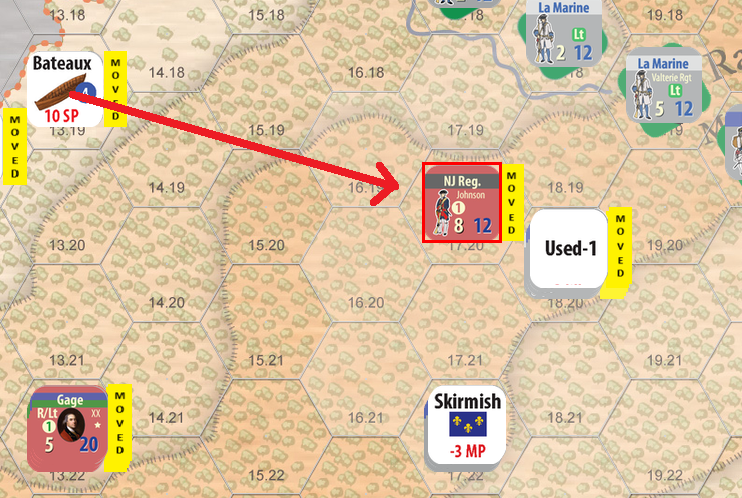
However, the NJ being aggressive, they start moving inland and follow the retreating French who still feel they don’t want to engage in combat.
The French take their second (and last) retreat option and pull back again, now all they back into the friendly fortifications where they lose the Skirmish mode automatically (due to stopping at a fortification).
I am landing the irregulars before most of the line infantry to ensure my strongest units can land uninterrupted. I want to save them for later engagements and not be delayed on the initial stage of the operation.
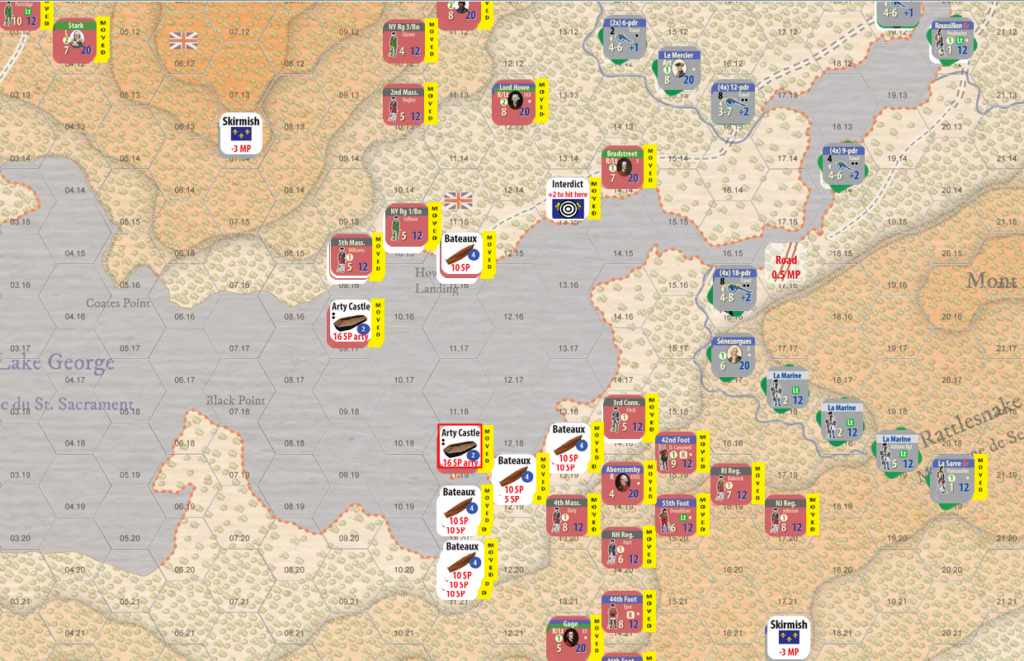
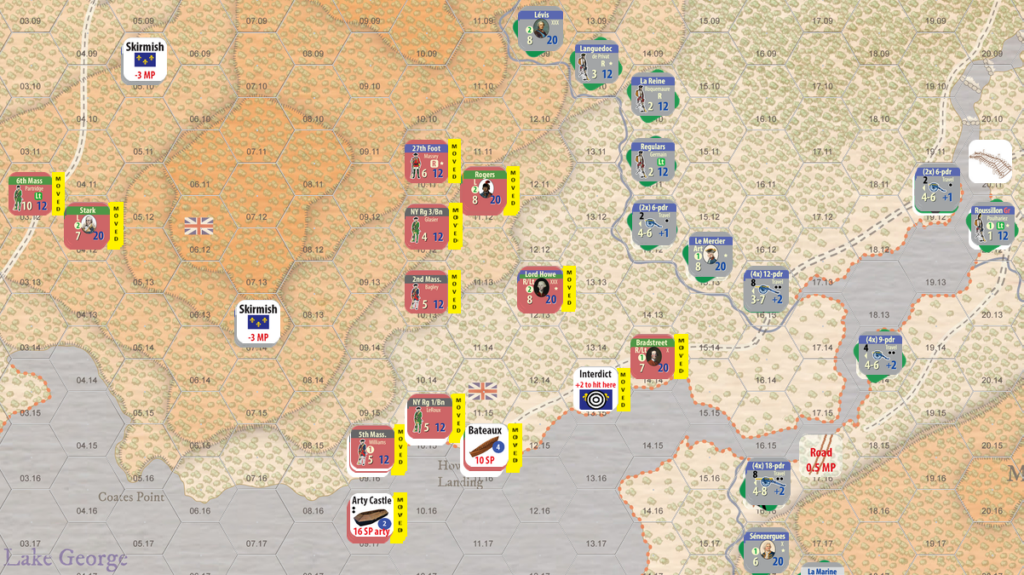
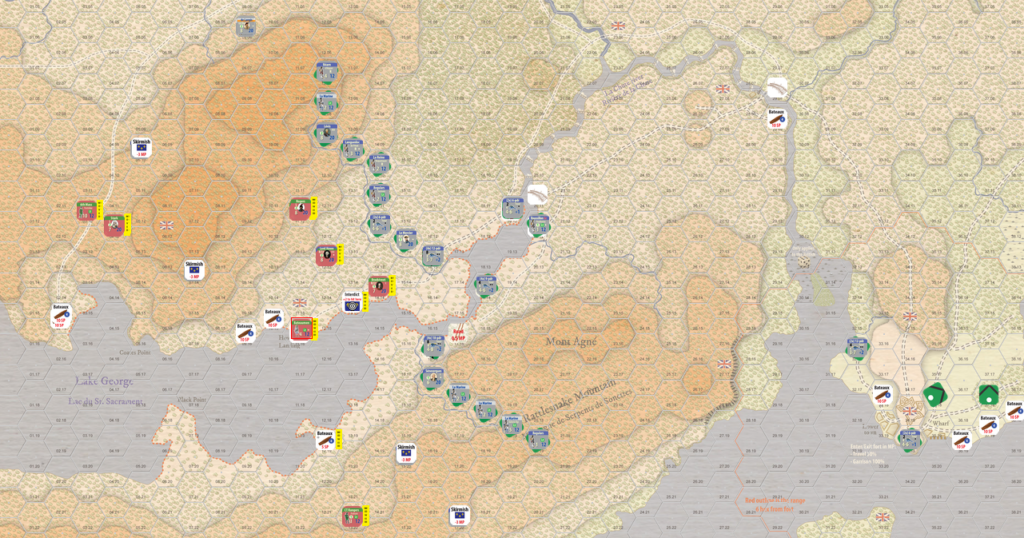
Finally, the whole army is on the shores of the lake. It is divided into two parts and really isn’t in any type of optimal situation. My idea is to tie up enough French on the western side (top part of the map) and hit hard on the opposing side.
The two Artillery Castles are still held back outside the effective range of the French cannons. Technically, they could have fired, but I didn’t bother now to speed up the game.
What will likely happen next is a French counter-attack against the weaker British on the western side… but that’s on my next post.
In this series of posts I will walkthrough several turns of the game play step by step using the rudimentary Vassal module I have been working on for the past several months. This will hopefully help players get acquainted with the mechanics of the 1758 Fort Carillon game. The module and art used are very much work in progress and are visibly incorrect in many ways. I will try to highlight those as I go through the game.
There will be inconsistencies in and between various images – this is a living project where many details are still being adjusted.
The starting setup in the “Montcalm’s Plan” scenario. The French are deployed into a defensive line with artillery close to the lake on both shores. Most units are also entrenched.
French setup
The French player has 40 build points that can be used to prepare defenses on the map. I have prepared a version that has a setup for an easy play. It can also be altered, if the players so agree. However, the 40 points are the cap and all constructions must be within that limit. I will not make any changes here and just go ahead with my saved scenario.
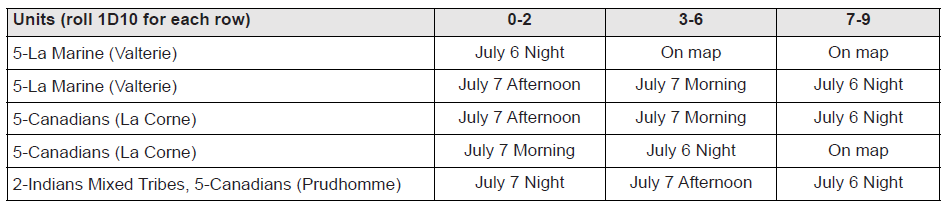
Part of the setup is the random French reinforcements. As “Montcalm’s Plan” covers the release of various troops to defend Carillon sooner than historically, let’s see when the remainder of those forces will arrive based on some die rolls.
The table for random French reinforcements.
I rolled five times: 5, 7, 5, 5, and 8. So, the troops will arrive by bateaux as follows:
5 SP La Marine starts on the map (SP = Strength Point, approx. 100 men)
5 SP La Marine will arrive on July 6 night
5 SP Canadians on July 7 morning
5 SP Canadians on July 6 night
2 SP Indians and 5 SP Canadians on July 6 night
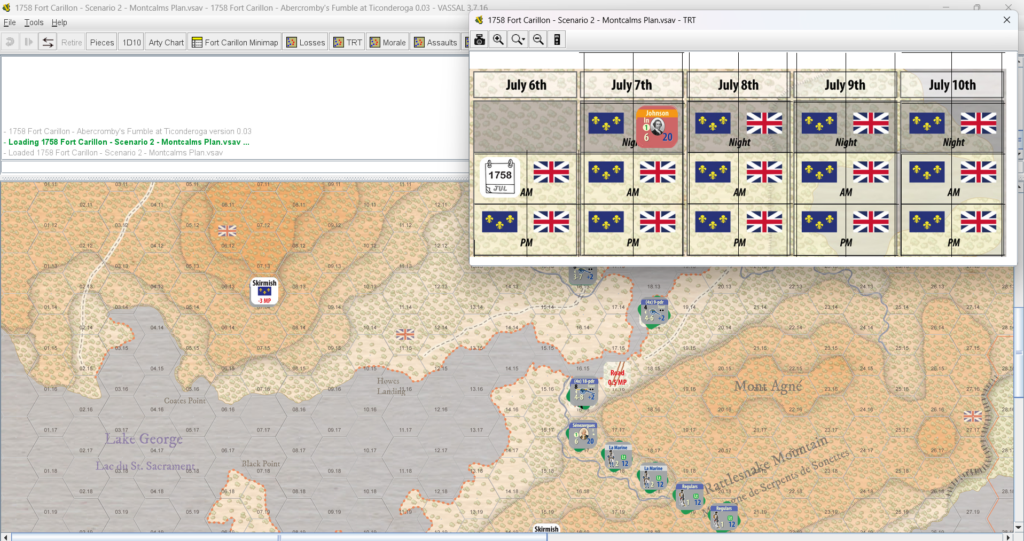
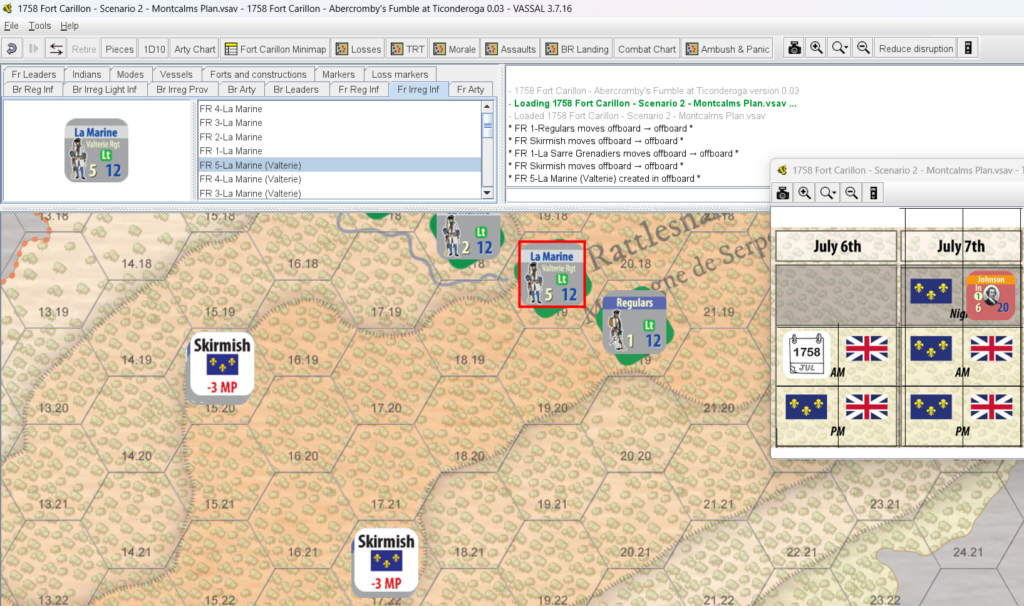
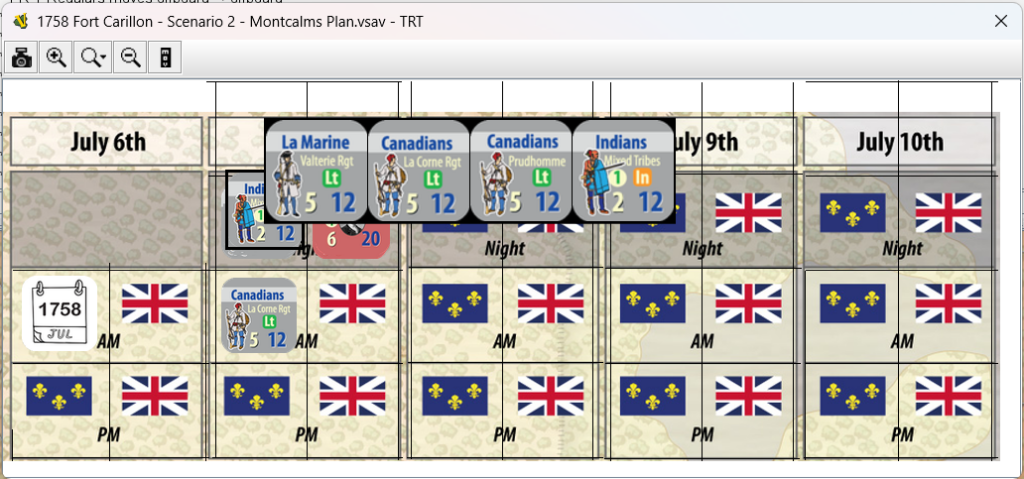
Next, I will find and place those units on the TRT (Turn Record Tracker) or as I still tend to call it, the Date and Time Track. As I received a strong 5 SP La Marine unit directly on the map, I decided to beef up my southern flank to discourage any British incursion there. This freed up some smaller 1 SP units from the entrenchments that I placed forward to support the skirmish line.
500 marines had arrived in time to join the troops on the French left flank.(The arrival of Johnson’s Indians is incorrect here.)
“July 6th night” is still on my version of the map under July 7. That will be corrected in the future – the Night Action Segment will move to the end of the previous day. A Maintenance Phase will also be added – it’s already visible in the squares covering the dates. I have not requested updates to the art for quite some time and try to fix most of them in one go.
The French reinforcements are now placed as per the die rolls earlier. Valterie/Valtrie, La Corne, and Prudhomme are just historical chrome and do not affect the game. These counters are interchangeable.
The remaining French artillery is left in the fort along with some irregulars.
At the north end of Lake George, French artillery protects the pontoon bridge. Not a bad idea, as Bradstreet’s bateaumen actually landed just short of the bridge.
The British Landing Commences (July 6th, Morning)
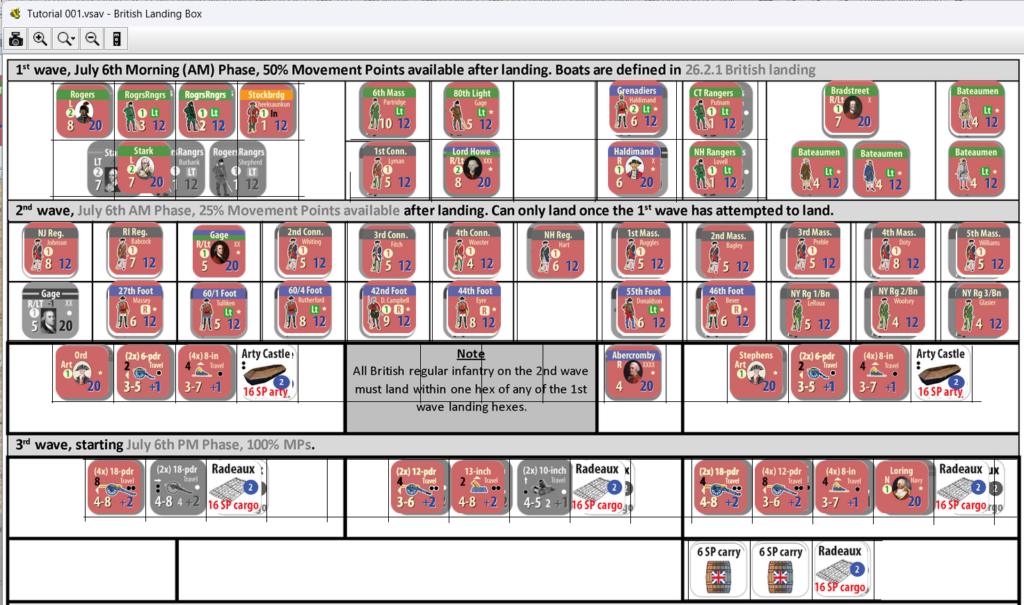
As I make no French movements on the first turn, I will now begin the British landing. It is divided into three separate waves; the first two take place on the July 6 Morning Action Segment. The third can only take place on the Afternoon Action Segment (or later) – this is when the artillery and supplies start to land. After adjusting the TRT, I will open the British Landing Box window and start with the light troops spearheading the main army. Yes, this screen is messy too, but I’ll get it sorted out.
To support the main army, two floating Artillery Castles are available. They may attempt to suppress some of the French artillery or bombard the earthworks.
The first wave with the Grenadiers, Rangers and other light troops are the vanguard of the vast British army. (While this view requires lots of cleaning up, it is good enough for now.)
The French Artillery Interdicts
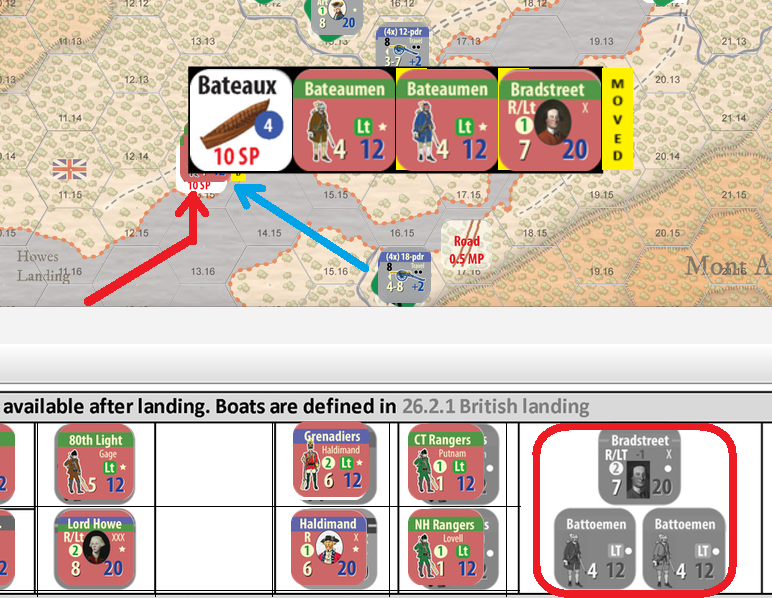
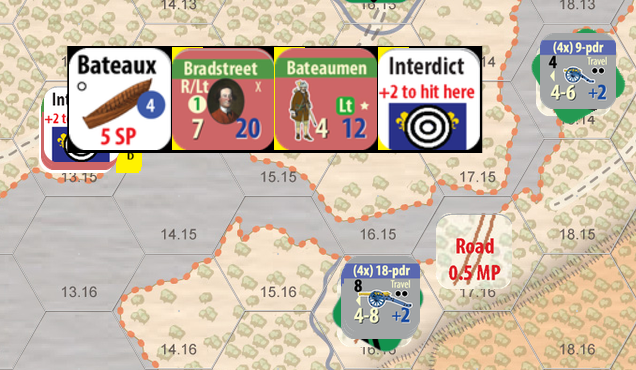
Bradstreet and 800 of his bateaumen are the first to attempt landing. They come in medium range of the French heavy artillery on the opposite side of the lake. An interdiction attempt will take place next.
One of the Bateaumen units is targeted (bateaumen, bateauxmen, battoemen… take your pick! Eventually, I’ll settle with a single term).
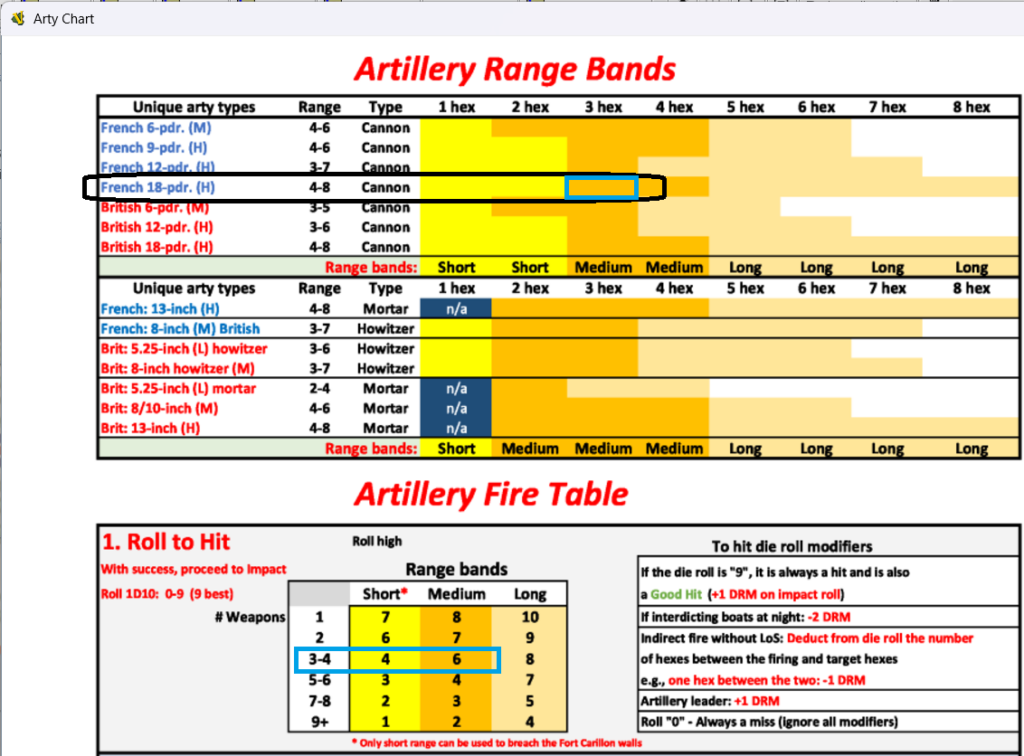
In the Artillery Chart below, we identify the type(s) of artillery first (here only French 18-pdrs) and check the distance: it is three hexes and thus uses the medium range band (orange) which I specifically highlighted with a blue quadrangle. The French also have an artillery leader giving a positive DRM (die roll modifier) for the to hit roll. Should multiple different types of artillery try to fire together, they all must be – in this case – direct-fire capable and also share the same range band (“effectiveness”). They could have a different range, but must be adjacent to each other and also have an artillery leader in range to fire together.
Die roll is “6”, and +1 for the leader DRM, thus the final roll is “7”. Looking at the medium range band for 3-4 pieces on the second table (Artillery Fire Table), it requires at least a “6” to hit (which we have here).
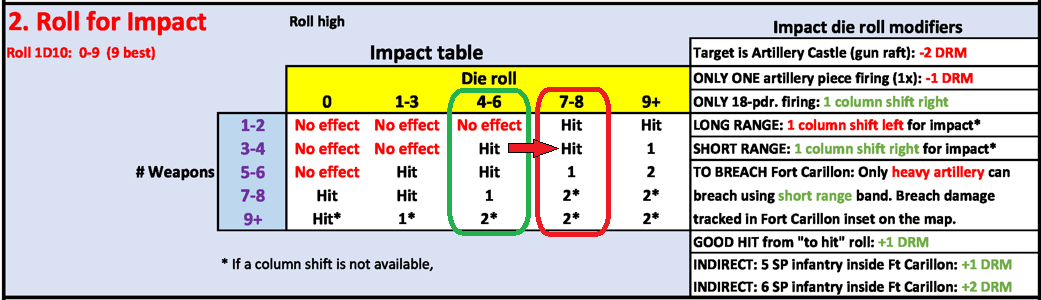
Good, then we’ll roll another time, for any damage. This can also fail completely with a bad roll, but as we have only heavy 18-pound naval cannons firing, we get a column shift right for impact – which is pretty good, because we cannot get a “No effect” on the target. A “No effect” is when you’d score some hits, but not enough to have a real impact within the scale of the game.
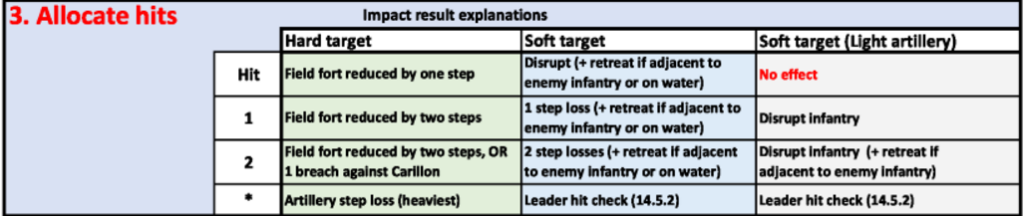
The roll is a “4”, and even with the column shift right modifier, the end result is the same on both columns – a “hit”. On the Allocate hits section, we choose the Soft target column, as only fortifications are a Hard target. A “Hit” states that the target unit is disrupted and must retreat as they were on water.
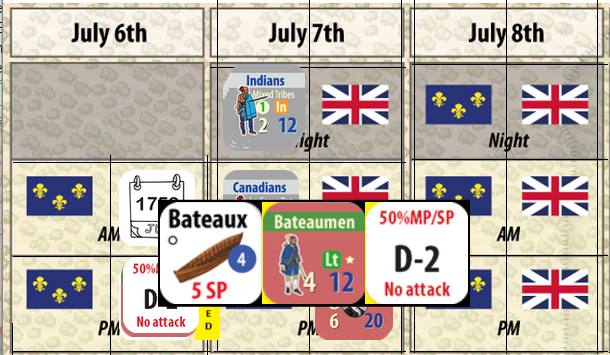
The whole stack is not forced to retreat, only the affected unit. It will not go back to the British Landing Track, but instead, it will be placed on the TRT, to the next British Phase (afternoon). It would normally be marked with a Disrupted (D-2) marker, but as they would have recovered by the time they can re-enter the map, this is not really needed. Recovery from disruption is automatic and will always be reduced by one step at the end of both player’s Action Segment. This is to ensure the unit remains disrupted through one enemy Action Segment – in this case, the unit will miss this segment anyway.
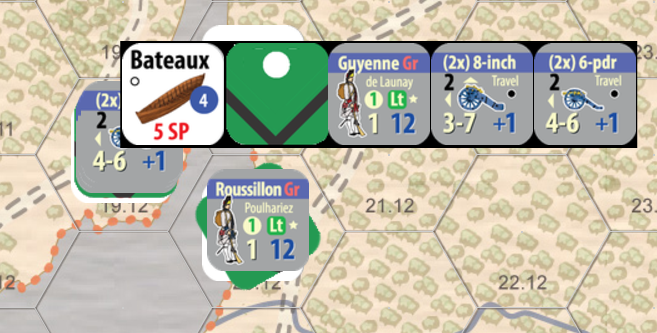
I also split the 10 SP bateaux into two smaller 5 SP counters.
Finally, I place an Interdict marker on the hex, where the British were hit. For any subsequent British attempts, the chances to hit are increased during this morning phase (+2 to hit on the same hex, +1 on all six surrounding hexes). The gunners have now ranged their guns. These will be removed during the Maintenance Phase, because I wanted not to think about artillery being relocated etc. That would have complicated the rules too much.
The remaining 4 SP Bateaumen and Bradstreet are allowed to continue their landing unaffected (they could also have retreated with the other unit).
The 9-pounders seen below cannot interdict as there is land between the water hexes blocking their Line of Sight.
Once landed, the troops have half of their MPs left (6 MP), but they move only one more hex. I will land the remaining British further away to avoid the powerful artillery.
The Vanguard Lands
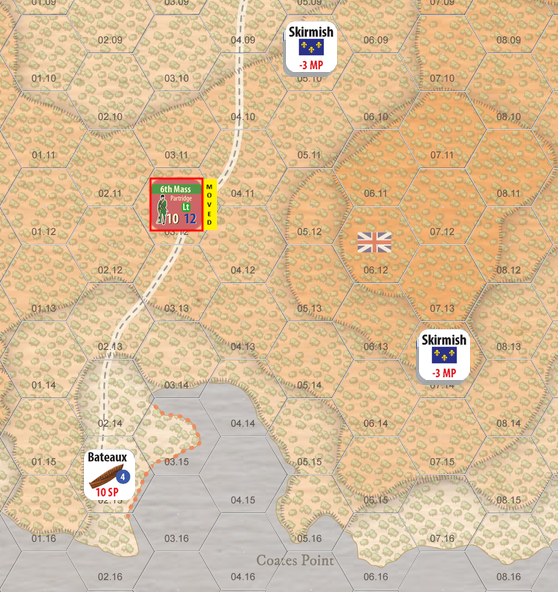
As the next unit to land, I chose the 10 SP strong 6th Massachusetts light infantry regiment. Units cannot use any other mode except normal movement after landing, thus I don’t want them to run blindly against the enemy and keep a distance to the lurking French patrols in Skirmish mode. Had the 6th Mass. moved any closer, it either would have been subject to an ambush or allow any Skirmish mode units to retreat to a more favorable position.
I’ll just go ahead and land more troops.
Below is where I landed my vanguard. The second phase troops, which are the main army, must land within one hex of these landing hexes. “No sane commander would blindly land his army without any reconnaissance,” right?
The Main Army lands
This being a game allows me to explore how different decisions could have affected the outcome. Finding a strong line of defense facing the planned landing area changed, I made the decision to go for the opposite, eastern shore of the lake. Let’s see how this plays out!
There was only one small unit that had come to the shore as part of the first wave, but that should be enough. And if it is not, this operation will fall apart!
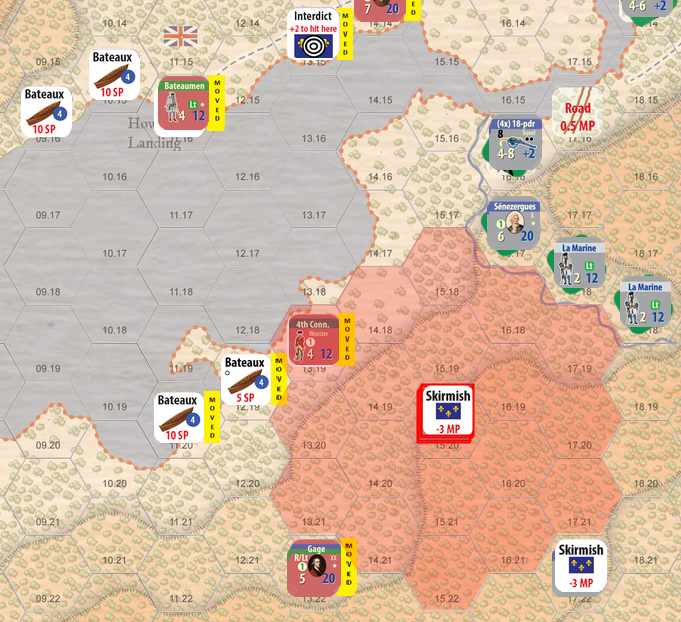
To expand the landing area and accommodate more troops, I had to land on Skirmish ZoC of the French (red shaded area).
My 4th Connecticut Regiment landed on a hex within the defender’s Skirmish ZoC enabling them to attempt an ambush. Let’s see what happens…
I rolled “8” – the target takes a step loss and has to retreat. As they arrived by boat, they have to retreat by boat into the TRT, the next friendly Phase (afternoon).
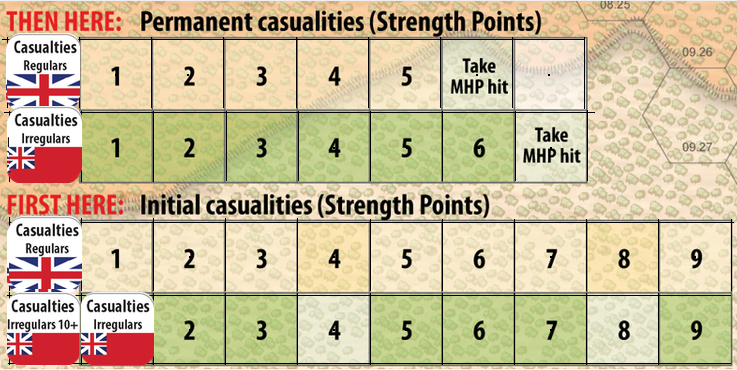
Infantry casualties are tracked in two different ways, first they go to either regular or irregular Initial Casualties Track and after four SP losses of the same type, one SP can return as replacements, while the three remaining will go the Permanent Casualties Track. After a certain amount of permanent casualties, Morale takes a hit.
As this post is getting quite long, I have decided to publish whatever I have so far and continue the turn in a future post – hopefully within a week or so. I will also be fixing the language, spelling errors etc. over time.
The battle of Bomarsund was part of the Crimean War, although mostly fought a thousand miles away from the main action in the Black Sea. In 1854, a combined British and French army assaulted and captured the Russian fort in the archipelago between Sweden and Finland. The fort was far from being complete, but it could have been a formidable location had the Russians made a better effort to finish it.
In the so called first battle of Bomarsund, Charles Davis Lucas tossed a grenade overboard just moments before it exploded thus earning the very first (earliest) Victoria Cross.
Finally, after several years of being in the neighborhood (we sail there frequently), I had the chance to visit the site. Not much is left as it was blown to smithereens after the capture. The British and French had no plans to stay through the winter and Sweden did not accept to take over the Åland Islands which had been part of Russia since the Finnish War of 1808-09.
There is a brand new visitor center with a rather small display of the historical events.
It does have some quite interesting maps, drawings and models of the historical fort. Only the red parts had been completed and yellow had been started but not completed. One seventh of all work had been done by the time it was destroyed!
Not many guns, or cannons, are preserved. I assume these are more or less original.
At least they had some Russian stamps on them.
Also, very little of the actual fort is still there – small sections of the walls here and there. But, it was a big fortification with a town (or two) around it. Also, several batteries and towers were built and/or planned around the area.
We also stopped by one of the cemeteries that had been built on the island. Supposedly, the intention was to build a large town in the area and thus the cemetery was very large. Only a small section of it had been used and there was also another one that we did not visit (it had a Jewish and a Muslim section). This one had been prepared for Christians only with separate sections for Roman Catholic, Orthodox and Lutheran deceased.
The Roman Catholic section had a handful of graves of Poles, possible from the time of the Polish Rebellion in 1830s.
Also a number of Russians were buried here – including the four siblings of Kuptchikov – a sobering reminder how well off we are today.
The final land-based field battle of the Great Northern War took place in the small village of Napue, Finland, on February 19, 1714.
I took a day off from work and spend 9 1/2 hours driving there and back to see the field (as my spouse called the trip). Of course, all the museums were closed at the time as the summer season is really short in Finland and they hadn’t opened yet. That didn’t stop me as I’d have likely no other chances this summer to go there.
The modern war memorial erected more than a century ago.It has a sign with roughly the following text: “The Expanses of Ostrobothnia. You can prove that we fought on this field. We did not fall back an inch from the path of duty and patriotism, but we fell in our place to the last man, leaving to future generations a legacy of our obligatory example of standing on the side of the fatherland in hard times, just as we stood on this field and, if necessary, fall to the last man, just as we fell on this field.“
The Battle of Napue
This was the final large-scale battle that took place on the Finnish front in the Great Northern War and essentially destroyed the Swedish army there. From now on I will call this a Finnish army, because it was made of Finns with very few Swedes (officers mostly).
After the decisive Battle of Poltava, the war had taken a serious turn for worse for Sweden. Russia and Denmark had planned a final blow by Denmark invading southern Sweden and, at the same, Russia keeping pressure up in the north, in Finland. Although the Danes had been repulsed in the Battle of Helsingborg (my recent playtest report), Peter the Great had already taken over the Baltic states and by the summer of 1713, his troops also conquered large parts of southern Finland. The Swedish-Finnish army was in a bad shape and did not offer battle until thei commander was replaced with General Carl Gustav Armfeldt.
The village of Napue, in the Isokyrö (Storkyrö) area, was the scene for the final and decisive battle in the Great Northern War in Finland. Image from Google Maps.
Armfeldt decided to engage the advancing Russians in Napue, a small village in the historical Ostrobothnia region along the road towards Vaasa, an important coastal town. It was a now or never moment and he also counted on the local villages to supply him with enough militia to contest the larger Russian army.
The Finnish army set up their regiments in such a way, that they would make strong assault against the enemy before they had fully deployed on the battlefield.
Map of the battle. Black are Russians and white are Finns. The Russian columns were advancing along the river from right to left. The river was frozen in February. Image National Library of Finland.
Armfeldt’s plan almost worked but he simply didn’t have enough troops. The 5,500 Finns were overstretched against the 11,000 Russians with almost half being cavalry. The Russian left infantry wing was engaged with a famous Carolean charge and almost crushed even with the reserves coming in. The plan was to break the line in one place and then roll it up and force the enemy to flee. It was very close until the 2,000 strong Russian cavalry bypassed the Finnish line on its left and hit the rear.
As the almost intact Finnish cavalry fled, the remaining infantry was overwhelmed and ended up being slaughtered. Local towns that had supplied militia lost 40-70% of their male population, and the whole army took 2/3 as casualties, mostly dead.
A mass grave of the fallen behind the Isokyrö church built in 1510s, on the location of an earlier wooden church from early 1300s.
The aftermath was brutal – the start of the Great Wrath. This is a time when the occupiers took a free hand of murdering, pillaging, raping, torturing, taking slaves, and so forth. For the next several years, these communities were savaged mercilessly. The intention was to create a scorched-earth buffer zone against Sweden to prevent any incursions in the future. It worked for sometime.
The battlefield is peaceful farmland today. People go about with their lives, perhaps occasionally remembering those who fell on the snow-covered field in February, 1714.
(Added June 13, 2025) The battlefield as defined in the online database managed by The Finnish Heritage Agency.
Experiments
As there are no games covering this battle (as far as I know), I have experimented using some existing systems with the hopes of being able to have a scenario released sometime in late 2025 or during 2026. It was quite encouraging to see that even with little preplanning, the game seemed to flow fairly historically, provided some special rules were added for historical accuracy.
From our beloved neighboring country, Sweden, comes a truly interesting Winter War game: Stalin’s Lost Chance (SLC). This hex-and-counter wargame from Three Crowns Games (3CG), using a chit-pull activation mechanic, covers the Soviet Union’s attack during the Winter War north of Lake Ladoga in 1939–40. The topic feels quite fresh—while games have certainly been made about, for example, the battles of Tolvajärvi, the operational scale is not typical. In this game, units are either Finnish battalions or Soviet regiments, or smaller detached formations. The game progresses in weekly turns until the end of the war, with a map scale of 5.5 km (~3.5 miles) hex.
The rough map area of the game in Ladoga Karelia.
I first tested SLC in autumn 2024 at the Baltic Wargaming Convention in Espoo, Finland and was immediately sold. Of course, the theme—Winter War at the operational level—had a big impact on that. After playing GMT’s Red Winter about a year ago, I was left wanting something a bit broader in scope, covering the decisive battles without the mass grind of the Karelian Isthmus. SLC isn’t exactly a short game, but I feel it depicts winter warfare quite well. The Red Army is tied to the road networks and can’t pursue the Finns into the forests—at least not in the early stages, before more ski troops arrive. On the other hand, they have plenty of brute strength—sometimes you just have to push forward with sheer mass and hope for the best.
The Red Army crosses the border via five main axes, and the Finns must first recover from the shock of war, scattered units, and Soviet tanks. Over time, reinforcements trickle to the front, and in my own games I’ve been able to stabilize the situation reasonably well—though it’s been a race against the clock. That’s just my own experience, of course, keeping in mind that the opponent might be experimenting a bit 😊 Around the midpoint of the war, massive Soviet reinforcements begin to arrive at the front, and the pressure on defense ramps up. Can the Finnish forces keep the Red Army at bay until the end of the war?
The game was designed by Stefan Ekström and Magnus Nordlöf. Assisting in the development is Australian Paul Shackleton, who is actively involved in 3CG’s projects. The game mechanics are part of the WWIIB series, built around a chit-pull activation system—each HQ to be activated next is randomly drawn from a cup. This adds unpredictability to the game, as it’s rarely clear who will move and fight in the upcoming turn. Otherwise, the system is traditional hex-based wargaming, involving probability assessments and random events.
Starting situation. In the picture, northwest is directly up, and Lake Ladoga is at the bottom. The number of units can be a bit misleading since the numerous Finnish units are usually small independent battalions (“ErP”). Photo Ola Palmquist.
The War Begins
Historically, the Soviet Union had concentrated the forces of the 8th Army in the area: two army corps comprising 120,000 men, along with tanks, artillery, and aircraft. The strength of these forces surprised the Finnish General Headquarters, which had only two divisions and various other miscellaneous units to oppose them. Later, the Red Army established two additional armies in the region—the 14th and 15th—to breathe new life into their stalled advance.
At the start of the war, Soviet tanks caused panic among the defenders. In the game, this is modeled by having the Finns suffer from “tank fear” for the first three turns (weeks)—given the Finnish Army’s lack of anti-tank weapons and training. This allows the Red Army spearheads to make significant early progress into Finnish territory.
However, Soviet units advancing along the coastal road are harassed by the Mantsinsaari fortress, whose guns could fire “into the rear,” that is, onto nearby islands and even the coastline, thus hampering movement along this vital route. The main defensive orientation of the fortress was toward Lake Ladoga.
On the right is Mantsinsaari located in Lake Ladoga, whose coastal artillery disrupts the Soviet Army’s movement along the coastal road (the reddish hexes).
During the first few turns, the situation is difficult for the Finns. Moving units is sluggish, as there are very few activations available. An activated HQ can usually move the units under its command within a range of 6–8 hexes. In addition, one independent unit within range can be selected to move—these include, for example, ski troops, detached battalions, and a large portion of Soviet tank units (at least in the early stages).
There are also different levels of activation chits: for instance, Colonel Talvela, who soon arrives in the area with the mission “to defeat the enemy forces advancing toward Korpiselkä and Ilomantsi,” can activate either Detachment Ekholm operating farther north or Detachment P (Pajari), which is active in the Tolvajärvi and Ägläjärvi area. On the Soviet side, each army can activate any of the division-level units under its command. More of these army activation chits become available later. The units are color-coded, so identifying the right ones on the map is straightforward.
Formations cannot be reorganized freely—one must operate as a whole: regiments or brigades belonging to a particular division must remain within the range of their HQ. If a unit strays off down some forest trail on its own, it can quickly run into trouble, as reactivating it may require moving the division HQ away from the main battle area to get closer to the unit.
In both of my test games, I played as the Finns against 3CG’s Jan, who controlled the Soviets, so I haven’t directly experienced the challenges the Soviets face with movement and launching attacks. Units are divided into two types—those capable of skiing and those that are not. With the Finns, this usually isn’t something you need to worry about, as most of them are forest-capable. That’s why I was nearly stumped when dealing with the more poorly equipped 23rd Division, which arrived later as reinforcements—how are these guys supposed to operate?
Units marked with blue movement points are in supply even in the forest, off the road, but only when next to a unit that is on a road. Only partisans operate completely freely. The picture also shows a few Soviet ski troops.
Tanks can only move along major roads and are generally at their best when used offensively. In the snowy forest terrain, supply works only and exclusively via roads or through an adjacent friendly unit. Only ski troops can move without such restrictions. Especially in the early game, the Red Army has only a few ski-capable units, meaning the bulk of the army is tied to road networks. More ski troops arrive later as reinforcements.
Tanks create disorder during the first weeks, and the Red Army has a clear advantage in activations.
Each turn includes a roll for random events, and in our game the die favored the attacker, triggering artillery barrages that caused additional disruption for the Finns. These events vary based on historical situations and occurrences, covering things like Lotta Svärd (helps units recover), Lake Ladoga freezing over (allows movement across the ice), “Motti-Matti”, or poor flying weather.
At the beginning, the Soviets understandably have the initiative, so many Soviet activations are drawn from the cup—typically 5 compared to Finland’s 2. This balance shifts from turn to turn depending on the historical overall situation. Once the initiative moves to the Finns, more Finnish activations become available.
Tanks charge toward Ägläjärvi and onward in the direction of Tolvajärvi. The Finns have only scattered units in the area.
Parade March to Helsinki…
The Soviets were expecting the Finnish working class to rise against their “oppressors” and thus gain a quick win – they even brought their parade equipment along. Neither happened.
As the Soviet tanks clear the way for the infantry to advance, the divisions turn into snake-like columns crawling through traffic jams. They spread out along the sparse forest roads toward the west, aiming to reach the rear of the Isthmus Army and gain access to Finland’s road network.
Randomness is introduced by cup activation (chit-pull). It’s rarely certain whose turn it will be next, so clever breakthrough or encirclement attempts can fall apart if the wrong group activates next. The Red Army is forced to attack constantly with low odds, but air support can be brought into areas of concentration, which the Soviets have in ample supply: initially, four units to the Finns’ one. The aircraft are either single- or double-sided, and they increase the combat odds accordingly by one or two levels (e.g., 1:1 becomes 3:1). This has a significant impact on the battle.
However, aircraft can’t be used freely because if the full power of a double-sided air unit is used, it takes two turns to recover. First, it goes into the Grounded box, from which it is moved to Refit on the next turn. If only the single side is used, the unit goes directly to the Refit box and thus recovers more quickly. The Soviets can also disrupt Finnish movement on roads or railways at strategic points by bombing the road network.
Red Army air units in different states of use. The more efficiently they are deployed, the longer it takes for them to recover back to operational readiness.
Traffic jams in the forests. The Red Army is mostly tied to roads and other routes, so their advance slows down and the spearhead keeps taking hits.
The Finns are forced to block key routes and must sometimes make tough decisions—should they try to stop the enemy by fighting now, or fall back to better positions and wait for reinforcements? Reinforcements arrive at the front painfully slowly, and movement from one place to another is far from swift. Behind the front lines, movement along roads or railways is naturally more efficient, but Zones of Control (ZoC) stop movement in the usual way. At the same time, the player must keep an eye on the distance to the HQ, as any unit that’s too far away can easily become stuck in place.
Reinforcements are steadily flowing to the front. The Finns initially scrape together forces that manage to halt the Red Army’s advance. After a shaky start, the Russians make a renewed effort with massive reinforcements.
Finland’s defense is based on two fundamental principles: first, forcibly blocking the roads, and then attempting to maneuver into the enemy’s rear to cut off their supply lines. Later, if the front can be stabilized, counterattacks become possible, along with efforts to form mottis (encirclements). Units must be used sparingly, but at times risks simply must be taken—for example, to prevent a breakthrough into the rear.
… Stalls in the Freezing Cold
When supply lines are cut, it’s essential to fix the situation. Usually, it’s Brother Ivan (the Soviets) who finds himself in trouble, and the parade march fizzles out once again. I’m pretty sure my opponent Jan was a real gentleman and gave me quite a bit of leeway during the game—many times I was able to flank into the rear and sever supply lines heading east. In addition, he often attacked with low odds, but on the other hand, his “legendary dice luck” kept helping me over and over.
At times, the Soviet situation was simply that the lead units needed to be sacrificed just to bring fresh troops forward from the rear and make use of the HQ more efficiently. Losses kept mounting, but then again, the attacker doesn’t exactly run out of troops anytime soon.
Losses at the end of Turn 7: destroyed Soviet units on the left, Finnish units on the right. Of course, damage has also been dealt to units still on the map.
A similar situation for the Russians during the fall 2024 prototype test. Quite a hefty pile…
Once I managed to shore up the defenses, I was able to start launching counterattacks on the Finnish side. I kept looking for weaknesses in the Soviet lines—and several emerged in different sectors. I was able to practically destroy the Red Army—perhaps a bit too easily—across the entire northern sector of the front. This freed up troops to move toward the shores of Lake Ladoga, where the pressure had been consistently much heavier.
The beginning of a motti pocket. Breaking out is not easy once you end up in this situation.
The remnants of the Soviet 139th Rifle Division have been encircled. South of Tolvajärvi, a second pocket is forming, containing elements of the 56th and the reinforcing 75th Divisions.
A motti (encirclement) diorama at the Military Museum of Manège @ Sveaborg fortress in Helsinki. Russians have dug in along the road and are pinned by the surrounding Finnish light units.
On the “southern front,” that is, along the shores of Lake Ladoga, we ended up bogged down in a stalemate. Both sides kept sending reinforcements to the area, and once Lake Ladoga froze over, the front widened—first for infantry, and later for tanks as well. The Finns had to respond by stretching their line, which in turn required additional troops. The two Finnish armored trains that arrive later as reinforcements provided some help along the railway. Only later, while writing this, did I realize how fierce the fighting around the Kollaa area had been on both sides. This is the area where also the sniper Simo Häyhä operated (there is also a movie coming). By encircling the Soviet spearhead units, we managed to destroy most of them—but some still escaped, which annoyed me greatly 😊. The flank threat worked well, meaning the Soviets couldn’t just mindlessly push forward without risking costly encirclements.
Did Kollaa hold? In this game, it didn’t hold—the village was lost, although the defensive line managed to stop the “budyonovkas” at the next hex.
The Red Army’s parade march stalled even before reaching Koirinoja, despite their furious efforts. The final nail in the coffin was the arrival of Jaeger battalions transferred from the Karelian Isthmus. This marked the end of our game—at the end of Turn 8—when we decided to call it. The situation along the shores of Lake Ladoga had reached a standstill.
Final Words
Stalin’s Lost Chance is not a one-evening game. We spent about 9 hours and managed to get roughly halfway through the war—and the game. It would have been great to continue further, especially as strong reinforcements had just started arriving to support the Soviets. I’m admittedly a relatively slow player, partly because if I’m unfamiliar with a system, even the basics take time, and I end up flipping through the rulebook now and then. On the other hand, 3CG has several games that use the same system, so over time the mechanics will become familiar. Jan even stayed up later that night playing solo, pushing deeper into Finland with his new reinforcements.
We didn’t calculate victory points, but I’m sure that, for the second time, Finland pulled off a straight-up sudden-death win.
For my part, SLC is going straight into the classics section of my game shelf—and not just because of the theme. This is also the first game I’ve ever ordered two copies of, and at under 50 euros, the price is quite reasonable. Stalin’s Lost Chance is an excellent combination of a clear rules system, varied combat styles and events, and great atmosphere. A few small things left me wondering—how feasible is the Soviet offensive in the later game? Did my opponent go too easy on me during the playtests? Do encirclements collapse a bit too easily? Then again, forming “motti” pockets isn’t all that easy either, so perhaps within the framework of the mechanics, we’re simply witnessing the larger endgame arc—it’s not meant to be a detailed simulation.
Other games from Three Crowns Games using the same WW2 mechanics focus either on the battles between Germany and the Soviet Union, or the North African theater. For example, Polar Storm covers the 1944 Petsamo–Kirkenes operation, where German forces were pushed back into Norway in the far north.
Stalin’s Lost Chance starts shipping during June 2025. If you preordered the game, it will ship already in May.
I was told already a few years ago to have a Vassal module for the game… About a year ago I took a look at it and quickly left – it just looked like too much at the time. So, here I am again, taking another shot at it and now it’s kind of moving forward. Vassal isn’t the easiest thing to get into, but I am slowly getting the hang of it.
A draft of the module with some counters thrown into the July 8th battle.
The first objective is to facilitate testing of the still unfinished game, and the second one, is obviously to have a Vassal module for the game.
My first problem was really to get the counters imported into the module, but that turned out to be a fairly straightforward task – I asked ChatGPT to write me a couple of scripts to make individual image files out of the large files I get from my artist. A few python scripts and some tweaks later, I had them. Not perfect, but good enough to use in Vassal.
There are many more advanced functions I still struggle with but ultimately, I hope to have a digital helper – and not the full game.
Adding some logic, like taking step losses took some time to figure out. I ended up doing most of this manually as importing a data file looked like a messy option.
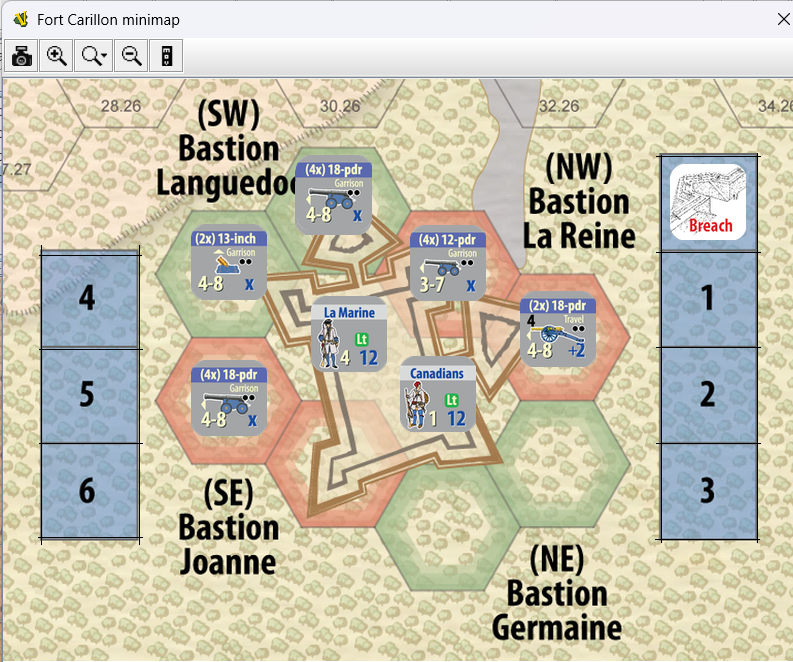
I am also adding some of the necessary components into the module.However, I still need to find a way to add some counters to these minimaps.
It’s been a lot of work to add all game counters with their traits.
Once I have the main components in the game, I’ll start testing myself and perhaps with a small circle of “testers”. Obviously, I’ll need less desk space and can also save the game, “put it away” for a while, and continue later. This is always an issue with kids, dogs and a spouse in the house…
In February, I attended the Friendly Fire de Luxe wargame event in Sweden. I had signed up in advance to test the new Great Northern War Battles (GNWB) game system, a project by Roger Sjögren that he originally started in the early 2000s. After encountering issues with the mechanics, the game was shelved and remained forgotten for nearly two decades—until his friend Mikael Rosenqvist asked if he had an old project that could be revived and refined. Roger obliged, handing over 20-year-old Illustrator files, which Mikael then reworked and revitalized.
In the original movement mechanics, it had been difficult to position units according to historical research. Roger revisited the available sources to determine whether new findings had emerged or if the same information remained valid. He soon discovered that a wealth of new research had reshaped the understanding of the Battle of Poltava, the event that initially inspired the project. Notably, in addition to the well-known Russian T-shaped defensive line, two other competing formations—labeled E and V—had been proposed, based on recent field studies.
The game system is still under development, and our playtest was only the second “public” trial. In the background, a map of the 1709 Poltava scenario could be seen.
Now, a couple of years later, the project has reached a stage where two battles are playable as prototypes: 1709 Poltava and 1710 Helsingborg. Most people are likely familiar with the first battle, either from the popular works of Peter Englund or from general historical knowledge. Personally, I wasn’t well-versed in the events between Denmark and Sweden, so Helsingborg was an entirely new discovery for me. Of course, there is even a Finnish Wikipedia article on the battle, but a quick read doesn’t leave much of a lasting impression.
The Battle of Helsingborg stemmed from Denmark’s attempt to reclaim Skåne (southernmost area in Sweden), which it had lost more than 50 years earlier. Sweden’s crushing defeat at Poltava in 1709 emboldened Denmark to declare war and launch an invasion of southern Sweden. On the last day of February 1710, Sweden—having hastily assembled and trained an army—advanced toward Helsingborg, where the invading Danish forces, numbering around 14,000 men, awaited them.
Danish commander Jørgen Rantzau had expected the Swedish troops to approach from a different direction than they did, emerging instead from the morning fog. This miscalculation left the Danish formation somewhat unprepared, forcing Rantzau to adjust his strategy on the fly. To complicate matters further, the Danish commander-in-chief, Reventlow, had fallen ill just before the battle, leaving Rantzau in charge at a critical moment.
This is the starting point of the game.
Initial Situation: The red Danish forces are slightly misaligned as they await the approach of the blue Swedish troops, who are advancing diagonally across the map along the road.
The battle begins at 11 a.m. and progresses in 10-minute turns using the traditional alternating IGOUGO model. The troops are organized into regiments, typically divided into two battalions and an artillery piece. Each hex can hold a maximum of 18 strength points, with one strength point representing approximately 33 men. Given that each hex represents 110 meters, a full-strength infantry battalion can fit within a single hex in a standard line formation. If necessary, the front line can extend across two hexes, though this disperses the unit’s strength.
During a turn, several key actions take place: executing commands, engaging in combat, or attempting to regain control of panicking troops.
We played with four participants, split into two per side. One player commanded the entire army and infantry, while the other led the cavalry. This structure allowed us to divide the game into four logical parts, enabling smooth execution of commands in a kind of “Agile Games” multitasking approach. My role was to command the Danish cavalry on both flanks. To my surprise, some infantry regiments were also mixed in with the cavalry.
Mikael, the graphic designer behind the game’s visual elements, took on the role of army commander. He had designed the map and game pieces, ensuring a clear and cohesive aesthetic. Roger had crafted the game pieces himself, while the map was printed in Germany.
Below is a picture of the Danish command structure. At the top was Rantzau, with my cavalry commanded by (von) Dewitz on the left and Rodsten on the right.
In the game, leaders receive orders that they execute to the best of their ability. Players have only limited opportunities to react to changing situations.
At the heart of the game is a command system in which players literally write down the army commander’s orders on paper. This mechanic has been present in war games for ages, but I had never played a game that used it before. My inspiration comes from the CWB (Civil War Brigade) series and other similar games.
The image shows the initial orders issued by the Danish commander-in-chief, which were executed immediately without confusion or delay.
At the start of the game, a few orders can be issued without interference—two for Denmark and four for Sweden. The two Danish orders were both directed to me:
Rodsten’s right-wing cavalry was ordered to advance toward Källtorp farm.
The left-wing cavalry was tasked with defending a gap on the western edge of Rinsgtorp farm, as the enemy was approaching from an unexpected direction.
I assume the intention here was also to pivot the front line, although the commander-in-chief didn’t explicitly communicate this—despite being just a few meters away…
Unit Objectives at the Start of the Game
In a movement command, a unit leader must advance toward their assigned objective using all available movement points. Units follow their leader, who operates within a command radius—the larger the leader’s influence, the greater the radius. If a unit falls out of range, it must take the shortest possible route back to reestablish contact.
Rodsten’s supporting infantry attempted to keep pace with the cavalry and managed relatively well. However, the first major obstacle was the streams and swamps of Ladugårdsflon. While frozen, southern Sweden’s mild winters meant the ice was unreliable. Any unit crossing these obstacles had to roll a die to determine how many movement points remained and how many swamp hexes they could traverse that turn. A good roll allowed for steady progress, while a bad roll could halt movement entirely. As units advanced one battalion at a time, they naturally became dispersed.
A key aspect of the game is the limited player control—once a unit is set in motion, it follows orders, engages the enemy, and reacts as best it can. The player must anticipate events rather than micromanage every move. For example, avoiding an oncoming enemy without triggering a dice roll often means the original plan doesn’t unfold as expected.
Meanwhile, Dewitz’s division, tasked with a defensive command, attempted to move westward (left). However, the artillery on the road partially blocked the advance, forcing the division to stay in place once it reached its designated defensive position—unless issued further orders. Since defensive units can only move one hex per turn, their progress was frustratingly slow, a limitation that would later prove costly.
At the same time, the Swedish army launched a full-speed cavalry advance toward the eastern edge, heading for the same farm that Rodsten and his forces were targeting. Swedish infantry and artillery followed the road directly toward the Danish position. I could almost hear the thunder of hooves as the blue mass charged forward, skillfully maneuvering around obstacles like forests and buildings at breakneck speed.
The Swedes advance rapidly as the Danes attempt to realign their front. We marked the objectives with blocks.
Since a new command can be issued during a turn, at 11:10 a.m., an order was sent for von Hesse’s infantry wing to reposition. A messenger was dispatched to deliver the instructions to the German mercenaries. However, receiving a message takes time, depending on the distance—and even then, its acknowledgment isn’t guaranteed. A roll of the dice determines whether the order is delayed, misunderstood, or even ignored, ensuring that nothing in the game is ever truly certain.
While Rodsten and Dewitz urged their troops forward and the Swedes thundered toward them, von Hesse appeared to be delayed—perhaps enjoying a bit too much aquavit. The message failed to prompt any movement, and when the army commander, Rantzau, personally rode to investigate, he found his troops still motionless.
Once per turn, a player can attempt to use an initiative roll to break a commander free from a stalled or unfavorable situation. However, there’s always a risk that the commander acts independently—and the dice decide the outcome. For instance, an aggressive commander may choose to attack even when a retreat would be wiser.
Below is the battlefield situation at 11:30 a.m. The Swedes begin organizing their infantry into battle formation, while both cavalry forces advance toward each other on the right side of the image. The Swedish horsemen carefully navigated the wet, difficult terrain, ensuring their formation remained intact. The blue and red blocks in the image indicate unit objectives. Since this session was a playtest rather than a competitive match, secrecy wasn’t necessary.
The battle unfolds as the troops close in, soon within striking distance.
At this point, tension was mounting in the Danish camp. Von Hesse’s German-Danish group remained completely stationary in the center—apparently still bogged down in the swamps. I suspect Rantzau may have had a sip of the famous aquavit himself, as even after an hour of trying to get his men moving, nothing was happening.
Meanwhile, part of the Danish artillery had been left far behind the front lines. To bring them into action, the Danes needed a successful dice roll to limber the guns, but luck wasn’t on their side. The infantry and cavalry escorts had already advanced well ahead, leaving the stranded artillery unable to influence Swedish movements in any meaningful way.
From that point on, action and chaos took over. The first clash came on the left flank, where Swedish cavalry probed the Danish defensive line, searching for weaknesses. Dewitz’s formation was not yet fully in place when the Queen’s Life Guard horsemen, led by Ascheberg, surged forward, already reaching the front lines.
The Swedish cavalry tests the Danish flank defenses.
And they rout the Danish cavalry unit.
Only the second battalion of Bülow’s regiment, made up mostly of Hungarians, had managed to cross the water obstacle when the Swedish assault began. At this point, the Swedes had to accelerate from the rear to close in at the correct assault range.
Since I wasn’t yet familiar with the combat dynamics, I asked the developer whether it was better to hold ground or counterattack. After a moment of thought, he replied, “Attacking is the best defense.” It turned out to be the guiding tactic for most of the game that followed.
Once units come into combat contact, ranged fire is resolved first. If neither side breaks, the clash continues into melee (melée). Every unit type—dragoons (mounted or dismounted), regular cavalry, and infantry—has specific combat values for both ranged and melee situations. The Swedish side even fielded pike infantry, whose combat stats reflect their specialized weaponry.
To model the nuances of 18th-century warfare, the game uses a fair share of dice—nine at once, in fact. These are rolled at the start of combat and then interpreted as needed. The black dice determine the initial outcomes—whether direct losses, disorder, or both occur—setting the tone for the engagement.
All dice are rolled at once in a bowl—just one roll needed.
The accounting system is reasonably precise, with combat tracked using ~33-man Strength Points (SP). Each unit has its own SP roster, and losses are marked off manually on individual tracking sheets as the game progresses.
The units are accurately modeled, and detailed records of losses are maintained.
An “X” indicates a destroyed Strength Point (SP), while a slash (“/” or “\”) represents disorder. Disordered units can attempt to regain cohesion if pulled back from the line, but both results remove the SP from the unit’s effective combat strength. Once a unit reaches the “X” threshold, it is considered shattered.
For example, the commander Dewitz (pictured above) will break if a sufficient number of subordinate units are shattered (“X”). In practice, it takes a considerable number of setbacks to even roll the dice for that—but once the threshold is reached, the risk increases significantly.
Next, if instructed by the table, you check the white dice. These often represent additional effects like broken SPs, and while not always direct losses, they tend to accumulate more easily and can wear down units quickly over time.
Battle tables are consulted using the dice colors—start at the top left.
At times, the situation on the battlefield got particularly tense. When a unit breaks and routs, a morale check must be made for all adjacent units—a mechanic that can, in theory, cause an entire line to collapse like dominoes. This happened more than once to the Danes, when multiple battalions suddenly abandoned their positions, leaving dangerous gaps in the line.
One especially comical moment occurred when a Swedish cavalry squadron, in hot pursuit of fleeing Danish troops, charged straight into the middle of the Danish army—momentarily flipping the chaos in the other direction.
In the photo, the cavalry of Västergötland charges greedily after the fleeing “Zealanders“ (Sjælland), plunging deep into the heart of the Danish army.
The Danes were nearing their fateful moment. With half the infantry unable to move and both flanks beginning to break, their line was on the verge of collapse. Fleeing troops streamed toward Helsingborg Fortress and safety, where desperate attempts were made to rally them and return them to the fight.
Once a unit lost its final Strength Point, it became a ghost—no longer functioning as a combat force. These were marked with Hattifattener tokens (a nod to the spectral creatures from the Moomins). While these ghost counters no longer represented active troops, they served an important purpose: they marked the spot where remnants could potentially be reassembled or recovered later in the battle.
The Danish right flank braces for a final stand against a double threat. On the opposite side, the left flank scrambled to contain the Swedish cavalry pouring through the lines—but it was too late. Most of the defenders were soon overwhelmed.
On the right, Rodsten’s troops fought to the bitter end. As mentioned earlier, attack is the best defense, and with no better option, a counterattack was launched—one last gamble to shatter the Swedes and open an escape route. For a brief moment, it looked like the bold move might pay off.
But the tide turned quickly. The second infantry battalion of the Prince Kristian Regiment, Denmark’s last reserve, moved in to stop the Swedes—only to break almost immediately upon contact. The foot soldiers had no chance against the cavalry, and their attempt to retreat turned into a routed massacre, crushed in a chaotic and one-sided pursuit.
General Rodsten’s final assault came close to success.
But soon, it was all over. The Danish line collapsed from every direction, and what came next would have been slaughter—so we decided to call it. After nearly 14 hours of play, we packed up at 11 p.m., having started at 9 in the morning with two meal breaks along the way.
Roger looked visibly satisfied. The game had been pushed to its limits, and many of the major flaws had come to light. The core mechanics held up well, requiring little change—what the system really needs now is clearer and more comprehensive documentation. We asked a handful of clarifying questions during the day, and several details of the map and markers came up for discussion.
The game system is heavy, and Roger himself describes it as being at “grognard level.” That didn’t bother us, though—we’re all grognards here. 😊
For me personally, the day was a deep dive into a significant moment in Nordic history—one I had known almost nothing about before this experience. And despite the system’s complexity, it delivered something rare in gaming: a real sense of being there, right in the thick of a major battle.
If the project makes it to publication, it might be worth considering a lighter version of the rules to help bring in a broader audience. A more accessible edition could open the Battle of Helsingborg to many more players—while still preserving the immersive, strategic richness that made this playtest so memorable.
In February, I participated in a five-day Friendly Fire (FF) wargame event in Sweden. FF is held twice a year in Rimforsa, south of Linköping, and focuses on wargaming. I planned a four-day trip, including travel from Espoo and back. Since the ferry schedules from both Helsinki and Turku didn’t align well with the event’s schedule and location, I opted to fly and rent a car from Arlanda for the three-hour drive from Stockholm.
The “de Luxe” version of the event differs from the regular one in that it is hosted at a hotel with full board. This was the sixteenth de Luxe event; in total, there have been thirty FF events over the years. The next one will take place in early October 2025. The event had around 35 participants, arriving throughout the week. The age range was approximately 16 to 70 years, skewing toward the upper half, though younger attendees were present as well.
Most local participants arrived by car, conveniently transporting games and plexiglass overlays. I traveled light, bringing only essential items. Surprisingly, many attendees came by train to Rimforsa, although the station is still a few kilometers from the hotel. Still, it’s great that the venue is accessible by public transport.
The event itself is free of charge, but participants must cover their own hotel and meal expenses. I booked a Middle Scenario package, which included three nights (Thursday to Sunday) with meals.
Friendly Fire’s Rimforsa Strand is located about a 3-hour drive from Stockholm.
Arrival & First Impressions
I didn’t plan anything specific for the first day, opting to go with the flow and see what was happening. Before attending, I only knew Stefan and Jan from Three Crowns Games, and I don’t speak Swedish beyond Finland’s compulsory studies. The reception was warm—some were even surprised: “All the way from Finland? Our eastern provinces!” After a brief orientation, I got a sense of the event’s atmosphere.
On Friday, I signed up to test Roger Sjögren’s Great Northern War project for the entire day. I’ll write a more detailed after-action report, but in short, the game simulates 18th-century Carolinian warfare in detail, incorporating command chains, order delays, misinterpretations, general uncertainty, and the chaos of battle. While it looks like a typical hex-based game, these elements add significant depth. So far, the game is for personal use only, but time will tell if it becomes a free or commercial product.
On Saturday, I scheduled only demos of my own project, leaving Sunday completely free.
This isn’t a huge convention, but for me, it was a new experience to immerse myself in board gaming for several days without everyday distractions. I initially assumed many sessions—such as a full-con run of World in Flames (Europe)—would be pre-arranged. However, on-site, I found that wasn’t a concern. Many lighter games were organized spontaneously, and participants were recruited for larger games as seats became available (e.g., Here I Stand). Of course, pre-booking is helpful if you want to secure a spot in a specific game or stick with familiar company.
World in Flames continues, spanning the entire long weekend.
There was no shortage of games—the selection felt like a well-stocked game store from decades past! Simply showing interest—whether by asking questions or signing up—was usually enough to secure a spot in a game. And I can say there were plenty of game bags packed with all kinds of wargames.
Both two-player and larger multiplayer games filled the tables. This event is a fantastic opportunity for like-minded players to fully engage in multiplayer games with five or six participants—without the usual rush of everyday responsibilities. I’d say these larger projects were the most popular.
Games for all tastes – here are the bags for one participant.
Prototypes & Playtesting
Several test versions of unfinished games were available, particularly from Three Crowns Games, which showcased nearly all of its playable prototypes—five new games and one updated edition. The selection included:
“Allenby’s Gamble” – The British in Palestine, 1917
“Colossus Stumbled” – (If I recall correctly, the Second Battle of Kharkov, 1942)
“Tolling of the Bell” – Hungary, 1945 (new edition)
“Fighting Hard” – Mersa Matruh, 1942
“A Most Bitter Blow” – Battleaxe, 1941
“Stalin’s Lost Chance” – Winter War, north of Lake Ladoga
Three Crowns Games had brought the latest prototypes to the test.
We scheduled a nearly finished proto of Stalin’s Lost Chance (Winter War) for Saturday—a game I had already tested once before (Google translate link). This meant my own project, 1758 Fort Carillon, would have to wait. I’ll write a separate article about the SLC session, as the developer was keen to ensure the game’s mechanics—especially the motti system—would resonate with Finnish players. When we last tested the game in the fall, some of these unique mechanics were still a work in progress.
3CG’s Stalin’s Lost Chance test.
Gallipoli 1915 & the LVP Incident
One of the long-running games was Gallipoli 1915, which remained set up for several days. Later, I read on forums that one Ottoman unit had been stuck in place for an extended period before finally launching a disastrous attack. As a result, the players jokingly awarded the unit the title of LVP (Least Valuable Player).
Happy atmosphere in Gallipoli.
At the event, I spotted 1985: Deadly Northern Lights in play. Watching these large-scale games unfold from the sidelines was tempting, but time was limited. At home, The Dark Valley currently takes center stage, so I had to move on.
There was enough table space for a bigger game.
The Venue & Atmosphere
Rimforsa Strand is a manor-style event hotel located on the shore of a lake. Coffee and snacks were available throughout the event, and the package included three full meals per day. Alcoholic beverages, of course, were separate.
By my count, there were eight dedicated gaming rooms or spaces, though I may have missed one—the building is quite labyrinthine, with rooms spread across four floors. The largest room alone housed six or seven gaming tables, and each “game table” often consisted of two or three physical tables pushed together. Aside from a few other guests, nearly everyone present was a player.
The hotel was an excellent venue for the event, though its remote location made it a bit of a journey for everyone. The cozy décor and delicious catering enhanced the experience. From time to time, I’d take a break, wander through the rooms to see what was happening, and grab some “supplies”—a fresh cup of coffee and something sweet. In the evenings, a drink cart was rolled out, offering a well-stocked selection of beverages for adults. Cheaper drinks could be taken from the fridge, with purchases recorded in a notebook on the honor system.
The hotel was very cozy.
Thursday: Quartermaster General
On Thursday, I was invited to join a six-player game of Quartermaster General, playing as the Soviet Union. QmG is a fast-paced, card-driven game of global conquest covering World War II. Most of us were new to the system, but it turned out to be easy to learn as we played. Italy led a strong push for the Axis powers—until, in the final round, I figured out a way for the Allies to snatch the last few victory points for the win. Great fun! Along the way, I also got to know my teammates, though there was less small talk during the game itself.
Thursday night warm-up with the Quartermaster General.
Friday: Helsingborg 1710—A 14-Hour Playtest
Friday’s main event was a 14-hour playtest of 1710 Helsingborg, played by four participants under the guidance of the game’s developer. With two meal breaks in between, it was an intense session! The turning point came about halfway through when the Danish defenses collapsed completely.
I usually avoid social media jargon, but honestly—this was an amazing experience! The Battle of Helsingborg was one of the bloodiest battles in Nordic history before World War II. As a result of the battle, Skåne became permanently part of Sweden. Before this session, I knew little about it, but by the end, I had a much deeper appreciation for its significance. A more detailed article on the game will be published later for those interested.
1710 Helsingborg playtest in progress. Photo Roger Sjögren.
Swedish troops break through the Danish left wing in Helsingborg. Photo Roger Sjögren.
One of eight game rooms.
Sometimes it’s also good to take a breather in the “library hall” and do the background work for the next project, for example, to get acquainted with the battles in Kharkov (Jan @ 3CG).
Saturday Night: The History & Gaming Quiz
One of the highlights of the weekend was the Saturday night quiz, held after dinner. This trivia challenge required both historical knowledge and deep experience in wargaming. My limited Swedish wasn’t the reason I struggled—I simply didn’t know enough! After just a few questions, I was out of the running. The main prize was a 3CG game, presented to the winner by its developer. Most of my own answers were just guesses, so I was never in danger of challenging the local experts!
The culmination of the weekend is a history and game-themed quiz.
Conversations & Collectors
Throughout the weekend, I got to know many participants. As a history enthusiast, it was easy to find common ground. I often just listened as others discussed topics ranging from World War I stormtroopers to the Battle of Gettysburg and even the tribal politics of 19th-century Afghanistan in the context of Pax Pamir. Many attendees had deep historical knowledge, and quite a few were game collectors—some with as many as 700 games in their personal libraries. Whether that’s a lot or a little depends on who you ask!
Sunday: Citadels & Final Thoughts
As Sunday wound down and people began heading home, I joined a game of Citadels to wrap up the weekend. My energy was already fading, but I managed to hang on. As expected, there was plenty of scheming, stealing, and assassination, but soon enough, it was time to pack up and head toward Arlanda.
Three days of 100% wargaming was the longest uninterrupted gaming experience I’d had since my youth. It left such a strong impression that I’ve already started checking my calendar—maybe I can return in the fall! Since Friendly Fire is held twice a year, there are plenty of chances to come back.
The water movement is kept quite simple on purpose (less counting of hexes). However, Fort Carillon typically hosts a large number of defensive artillery so I wanted to verify the movement and interdiction rules in the game now. I ended up making some small tweaks but I am fairly happy with the way it works now – once you get the hang of it. Below is the extensive playthrough in detail.
The British have gathered a force of 2600 men for the attack (26 Strength Points): 1000 “ordinary” Massachusetts provincials, 800 Mass. light infantry and 800 regulars from the 60th regiment. Coming to think of it, it’s an all-American force!
In defense we have 700 Canadian militia and 200 French regulars. But they have 14 pieces of heavy artillery and one heavy mortar with them.
The provincials start by rowing towards the undefended wharf.
Due to the limited visibility in the muddy waters with tall reeds impairing navigation, the British must make a roll when entering Lake Champlain from La Chute river. The “roll for the reeds” was 9, thus all traffic is directed to the south side of the marshy islet, away from the French artillery.
Even if firing at less than optimal range (3 hexes), the forward artillery with (2x) 9-pdr heavy cannons takes a shot, rolls 9 “to hit”, which is an automatic hit. Next the French roll again “for impact”. Medium range and two pieces – roll 0, miss. Cannonballs are scattered far and wide while the provincials row swiftly past the defending guns.
They continue to the real gauntlet as the heavy cannons guarding Lotbinière’s Battery were only 400 meters away at the narrow part of the lake. Two additional interdiction attempts were made: the said two cannons at a range of two and thus in Short range for maximum effect. No artillery leaders were present for additional DRM. Six was required for a hit, but a zero was rolled – automatic miss, ignore all DRMs. Then the four heavy 12-pounders located at the Bastion Joanne fired at a range of three hexes. Six or higher was required, a one was rolled. Even the +2 DRM to hit for all French artillery in Fort Carillon was not enough and they all missed (to the degree of making an impact in the game)!
The last line of defense here were the two 18-pounders at northeastern Bastion Germaine, which fired at the range of two. Six was required and the roll was eight. The Impact roll was the maximum “9” so the siege guns’ +1 DRM was ignored. One hit was scored and as no leader was present, the leader hit roll was ignored. 1 step loss was absorbed by Colonel Preble’s 3rd Massachusetts Regiment. The attacking troops were forced to retreat back to their point of departure. No more interdictions took place along the way back as all artillery had used their “one interdiction attempt per stack”. As the French hit a target on water, they could place one of the two available Interdict markers on the hex (it’s mislabeled!). This indicates their guns are now well aimed at this location and the hex gives an additional +2 DRM to hit with the six surrounding hexes gaining a +1 DRM.
Next came Partridge’s 6th Massachusetts – the only provincial light infantry regiment. They took the same path around the islet keeping their distance to the French guns aiming at them along the way. The French fire again – they can attempt to interdict each stack moving on water, once per phase. The French roll a five, but seven would have been required for a hit. Partridge’s men move on towards the undefended Lower Town next to the fort.
The guns at Lotbinière’s Battery had no line of sight, thus the cannons at Languedoc fire at three hexes. As each bastion has a limited field of fire, they waited as long as they could before the bateaux would have moved out of their sight. Then again, rolling a zero is always a miss. As the provincials moved to the next hex and were now visible to the four guns located in Bastion Joanne. They fire off at the two hex range: Short range, +2 DRM to hit, and they roll “9”. That gives again +1 DRM for impact. But the impact roll of “0” yields no hits!
As the Massachusetts regiment gets ready to land, they are now adjacent to the two guns that could not see them before. The French artillerymen turn their cannons around to face this threat and make the final attempt to fend off the attacking light infantry clad in all-green uniforms. Another zero!! The Town is lost… there is no reaction from French infantry as they all were hunkering down behind their fortifications.
The third and final “wave” comes in the form of the American-raised 60th Regiment of Foot and its 4th Battalion, commanded by Major Rutherford. However, George Augustus Howe, 3rd Viscount Howe – the tactical leader of the British expedition – had himself taken the lead of this attack.
The objective for the third “wave” is to get all the way to the rear of the French guarded only by a small detachment of Canadian militia. We go through the gauntlet routine once again: First cannons once again roll bad (2) and miss. The four heavy pieces in the fort can only fire at the range of five hexes. Yet another “0” – a miss. I need a dice tower…! Two more cannons take their shot at two hexes but only manage a “7” which is one short of a hit.
The redcoats continue rowing hugging the opposite shore keeping their distance from the artillery. The final attempt comes once again from Bastion Germaine with two cannons: at five hexes a seven is needed to hit (this is with the +2 DRM from fort). But they roll a three – miss. Now the Canadians can try to ambush the landing troops! Rolling “1” they fail miserably and actually have to retreat three hexes away from the British troops.
The British movement allowance was halved by water movement – from 12 to 6 MP – and the ambush itself cost the an additional one MP (made a small adjustment on the fly here). With their five remaining movement points, they get next to the Canadian militia unit protecting the French forward battery (and also the Canadians who vanished into the woods after their failed ambush). Howe is full of confidence as always and takes the enemy head on. You can only be ambushed once per phase so it’s time for infantry combat!
Howe leads the 60th regiment towards the French forward artillery position.
The redcoats charge uphill (-1 DRM) with Howe in the lead (+2 DRM) they have a pretty good chance of chasing the militia away (at 4:1 raw odds). There are two other militia units adjacent to the targeted Canadians, and the larger unit with 2SP sends half of their men to support the defense. The odds fall to a final 3:1 with +1 DRM. I am using the slightly more attacker-friendly version of the combat table. The roll is “4” +1 DRM thus a five. The table shows the attacker wins and both take one step loss. Backside of the British counter has only 5SP although it should be 6SP. It was a loss of 2SP so a little bit of steam was expended on the first attack.
As we are still going through the first round(s) of combat, let’s see what happens around the Lower Town where the Massachusetts light infantry landed previously – all combat resulting from the initial contact must be resolved before any additional fighting may take place. Technically, they are not forced to attack as all three parties are inside fortifications facing each other (I had removed the all-around field fort counter earlier but need one at least for the Lower Town). But they do want to attack and capture or destroy those nasty guns at Lotbinière’s Battery outside the fort.
I am still sticking with my current design where the field fortifications basically have three protected sides and the battery is not protected against an attack coming from the Lower Town. A hundred Frenchmen sally from the fort to assist the defenders so we are looking at 8SP against 3SP and -1 DRM making it an effective 2:1 attack. The roll is “5” and with -1 it’s a “4”. The attacker still wins (with a step loss) driving the French three hexes away. Now those captured French siege guns are actually threatening the fort as they are in the effective range to knock down the walls!
Back to the second round of combat and Lord Howe. His troops are adjacent to two enemy units and he decides to attack the one with artillery. Once again, the attack comes from the rear and there is no benefit from the redoubt. Well, at least right now – it’s debatable if they would actually cover 360 degrees in all cases. We have a 6:1 attack with +2 DRM. It’s an automatic win for the attacker but let’s roll the die to see how much the Canadians will suffer. My other version of the combat table would still let the defender win with a “0” but the DRMs in play would still make it an auto-win for the British. The roll was actually “6” and with DRMs it’s “8” meaning the militia is wiped out. The 60th takes another step loss so now the 5SP counter is correct. All French artillery outside the fort is now captured and if there is a second attack “later in the game”, the fort is in deep trouble!
This is the third and final post in my recent playtest series. Admittedly, it was a solo run, so I had to make some compromises during the gameplay.
In this game, time is of the essence. The British can steadily advance with their overwhelming army, but this approach gives the French the opportunity to decide how to respond to the oncoming redcoats. Of course, just retreating off-map isn’t an option (what kind of game would that be?). However, if the French allow themselves to be surrounded in the fort during a siege, their chances of survival will be slim.
The British strategy so far is depicted below. The main army landed approximately where they historically landed (depending on which source you reference). My focus was on the western (left) side of the map, while some provincial forces were sent to engage the French on the eastern side. This approach comes with risks: the French could potentially sally out in force and inflict significant damage on the provincials. However, such a move isn’t straightforward. A typical provincial regiment is larger than a French-Canadian regiment, and in this game, the odds favor the defender.
As the French executed their fighting retreat through the restricted terrain, the limited river crossings posed a significant challenge. The only viable options to bypass them required boats to be hauled over, making it easier to establish new defensive positions. Capitalizing on this, the French focused on blocking the two main fording points and began constructing not one but two lines of defense.
The first line is positioned just beyond the ford near the sawmill (close to the left edge of the upper blue line on the map). Its purpose is to slow the British advance and hinder their ability to efficiently move heavy artillery closer to the fort. The French plan to abandon this position as soon as the British are poised to overwhelm it. This delaying tactic also buys time to construct the historical breastworks closer to the fort. If the British player wants a decisive victory, they should press aggressively to prevent the French from fortifying their positions.
Meanwhile, the British artillery train remains at the beaches of Lake George, still in the process of being sorted and prepared for action.
Below, the heavy artillery is now being hauled through the portage toward the sawmill and the section of the La Chute River that leads to Lake Champlain. I also began replacing larger stacks with placeholder counters, which helps relieve congestion on the map board while adding a bit of “fog of war.” While it doesn’t match the guesswork or searching required in Pacific War, it’s a welcome addition in the ongoing quest to enhance gameplay.
By the time most of the British artillery was within range, the French defensive line was fully constructed. The numbered counters represent stacks of units, though I still need to find a proper off-map location to manage these stacks more efficiently.
Several boats were brought to the river to facilitate crossings, and the British opted for a bold strategy: cutting off the French forward defenses from their main body and striking at their rear. This maneuver significantly reduced many of the French advantages, though some of the forward troops acted more as a diversion than a serious force.
This attack forced the French off their defensive line, but at a cost to the British. Their morale had already taken hits along the way, and it suffered a final blow during one of the battles. Currently, in the game, morale does not recover over time—perhaps it should, maybe at a rate of one point per night? Further testing is needed to determine what makes sense and strikes the right balance.
Once morale sinks to a low level (currently labeled “precarious” in the prototype), players must pass a leader morale test. Failure means the campaign is effectively over. Historically, this mirrors the actions of the British supreme commander, Abercromby, who famously lost his nerve and ordered a retreat back to the camp at the former Fort William Henry.
History seemed to repeat itself as Abercromby failed the roll. While he’s a weak leader, rolling a zero will doom you every time.
This game took a turn for the worse for the British. They suffered losses along the way, and the death of Lord Howe—a devastating -4 to morale—was a significant factor. Both sides have strong leaders who can greatly influence combat, but using them always comes with the risk of losing them. An army leader cannot lead offensively and is instead restricted to defensive roles. That’s why he is placed in a box on the map and represented by the HQ marker. This reflects the reality of his historical role, leading from a safe distance rather than leading the charge (this is not the Plains of Abraham…).
I played a little further to see how events might unfold and to attempt to chase the French away. The final dispositions are shown below, with the French army now surrounded at the fort. If the British leadership had been in better shape, they could have pushed the artillery forward to prepare for an assault on the French lines.
With 1758 Fort Carillon, I aim to explore the Ticonderoga campaign in a way that goes beyond the iconic desperate French defense. Some of the scenarios are built around historical “what-ifs” and are designed to be more balanced and engaging for gameplay. It is not yet a fully ready or complete game, but I believe it’s finally(!) quite close to being a real wargame!