
I recently spent some time testing Perry Moore’s new game Kursk in Finland. The game depicts the decisive battles between the Soviet Union and Finland in the summer of 1944. Tali-Ihantala refers to two towns in what was then Finland—now part of Russia—where the mighty Red Army was repulsed and Finland effectively preserved its independence.
The Soviet summer offensive of 1944—Operation Bagration—was a decisive blow against the German Army Group Center. Some weeks before Bagration began, the Soviet Union launched the Vyborg–Petrozavodsk Offensive against Finland, aiming to force Finland out of the war. Three Soviet armies attacked on the Karelian Isthmus, while two more advanced into eastern Karelia.
With overwhelming firepower, the Red Army pushed forward and ultimately captured Finland’s second-largest city, Vyborg (Viipuri). (Side note: my mother was born there.) Facing this powerful enemy, Finland requested support from Germany. Some limited—but crucial—assistance arrived: Panzerfausts and Panzerschrecks, Detachment Kuhlmey (Ju-87s and Fw-190s), an infantry division, and a half-strength assault gun brigade. Not much in the context of this enormous struggle, but just enough to stiffen the defense. Even so, the Soviets outnumbered their opponents by roughly 20:1 in aircraft and armor.
The game begins as the Soviets continue their offensive after taking Vyborg. The town of Tali lies directly in their path. The Finnish army in the area consisted mostly of regular infantry, while the Armored Division was deployed in an adjacent sector.
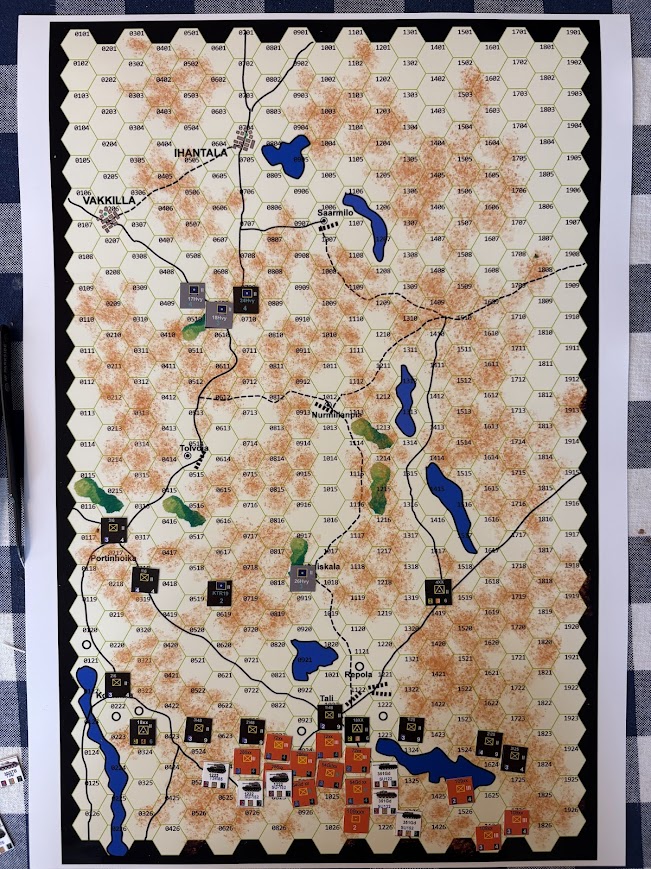
Rough starting locations on the standard map.
As a print-and-play game, the quality of the map and counters is largely up to the player. I didn’t spend too much time on production quality—as you may notice—particularly on the counters. They’re printed on glossy photo paper on one side and adhesive paper on the other. Good enough for testing purposes.
I won’t dwell too much on the “test” aspect, and will focus more on the game itself. Historically, the Soviet onslaught was halted through massed artillery fire and aerial bombardments that crushed concentrated Soviet armor and infantry. The same holds true in the game: these are the decisive factors. Infantry feels somewhat fragile and slow, and the fine line between victory and defeat depends on the effective use of heavy assets.
The Finns historically concentrated more than half of all available artillery in the entire army to counter the Soviet attack. Batteries from multiple divisions, supported by corps-level heavy artillery, concentrated their fire on single points—often obliterating enemy units before they could even advance. In the game, if you gain air superiority, you can bombard any hex on the map. Artillery, however, requires spotting, so many tempting targets remain untouchable.
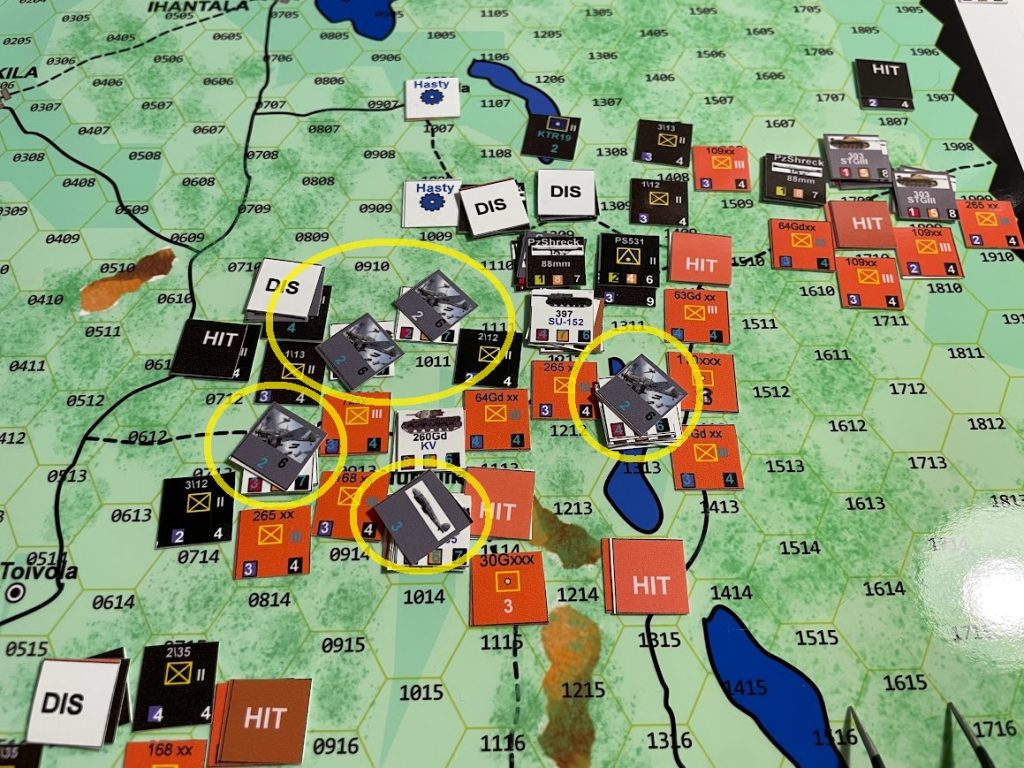
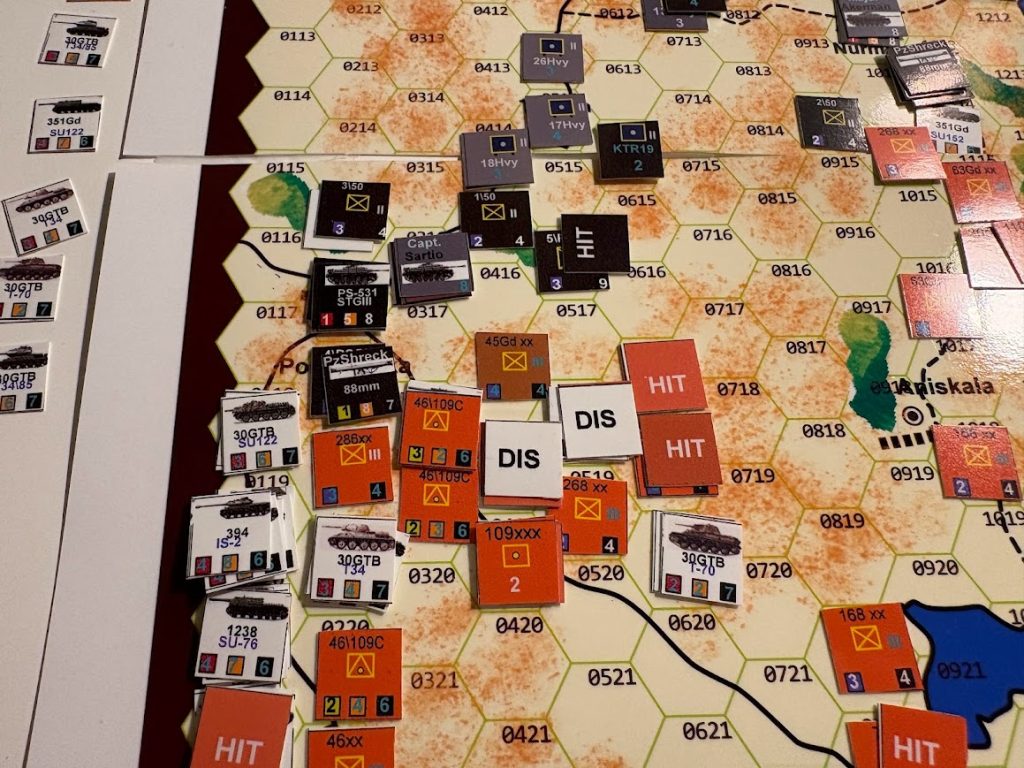
Concentrated air support can bring heavy firepower to any hex on the map. In this rare moment, Det. Kuhlmey delivers lethal packages. NOTE: I have edited the map file to make it… greener.
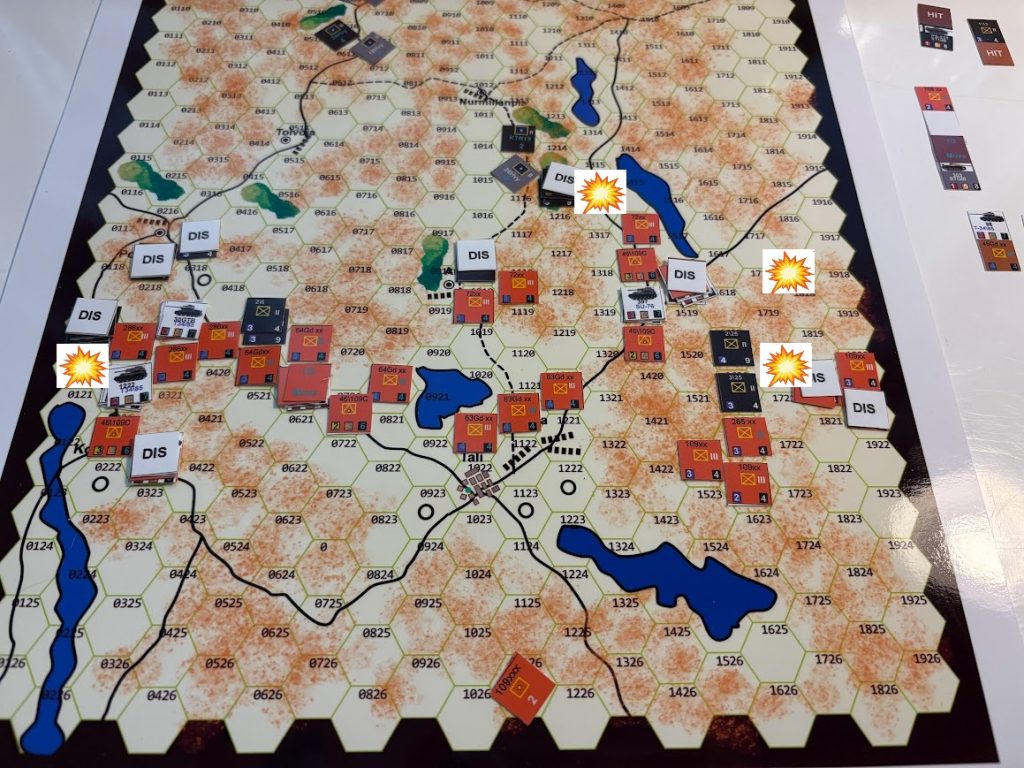
Artillery is the king of the battlefield—especially in this game. It will frustrate the Soviet advance time and time again.
The game system uses a fairly standard IGOUGO structure, with clearly defined segments for bombardment, prepared attacks, and movement + mobile attacks. Zones of Control behave as expected, and a disrupted unit loses its ZoC, allowing the enemy to bypass it easily. Due to their heavy armor, the Soviet player is largely constrained to road networks, while the Finnish player aims to block those roads, bypass strongpoints, and encircle powerful enemy concentrations.
Most of the map is forested, which restricts movement. There is randomness in both artillery and air support availability, as well as in combat results. Heavy IS-2 tanks and SU-152 assault guns are formidable Soviet assets. The Finns receive Panzerschrecks and StuG III assault guns as reinforcements. Even the tiny T-26 tanks and BT-42 assault guns are useful—they’re fast and project a Zone of Control. Panzerschreck teams can also be repositioned to stop or delay breakthroughs.
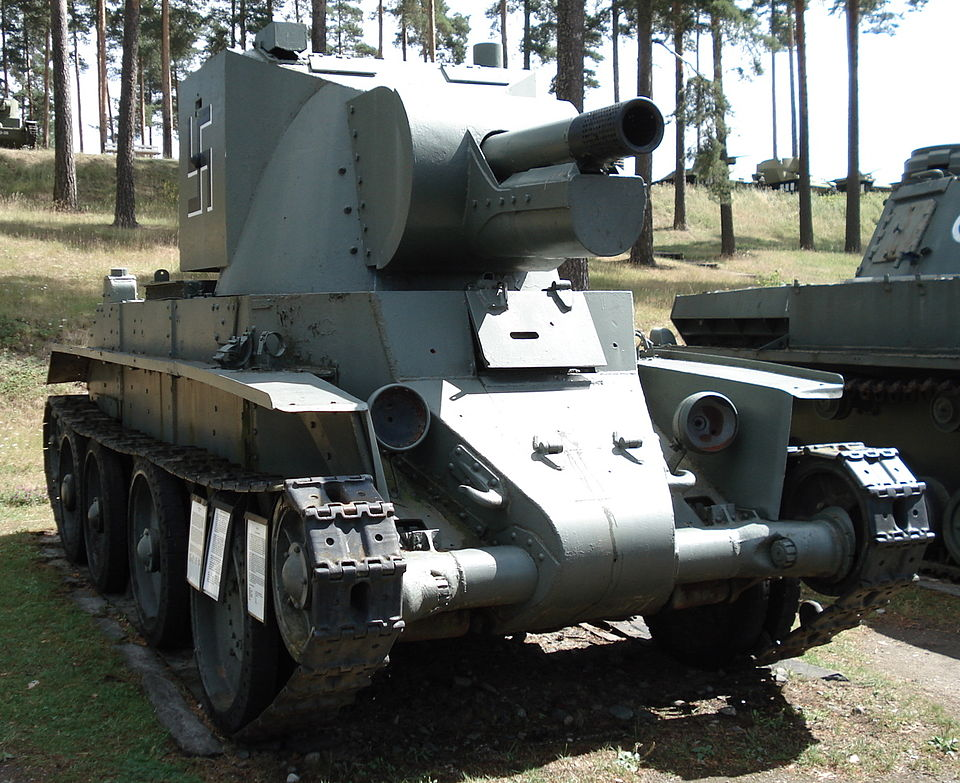
Image: https://en.wikipedia.org/wiki/BT-42#/media/File:Bt42_parola_2.jpg

While it’s possible to create defensive stacks that are immune to direct attack, they can still be bombarded into retreat and disrupted, causing them to lose their ZoC. Artillery and air support levels vary from turn to turn: air support is randomized every time, while artillery may receive additional ammunition if the Dice God is favorable.
The Finnish player must initially delay the Soviet advance as effectively as possible. As always, this is a balance between preserving strength and conceding ground. Once the Finnish counterattack begins, the roles partially reverse—not completely, but enough for the Soviets to start feeling the pressure. A change in initiative can even result in a double turn.
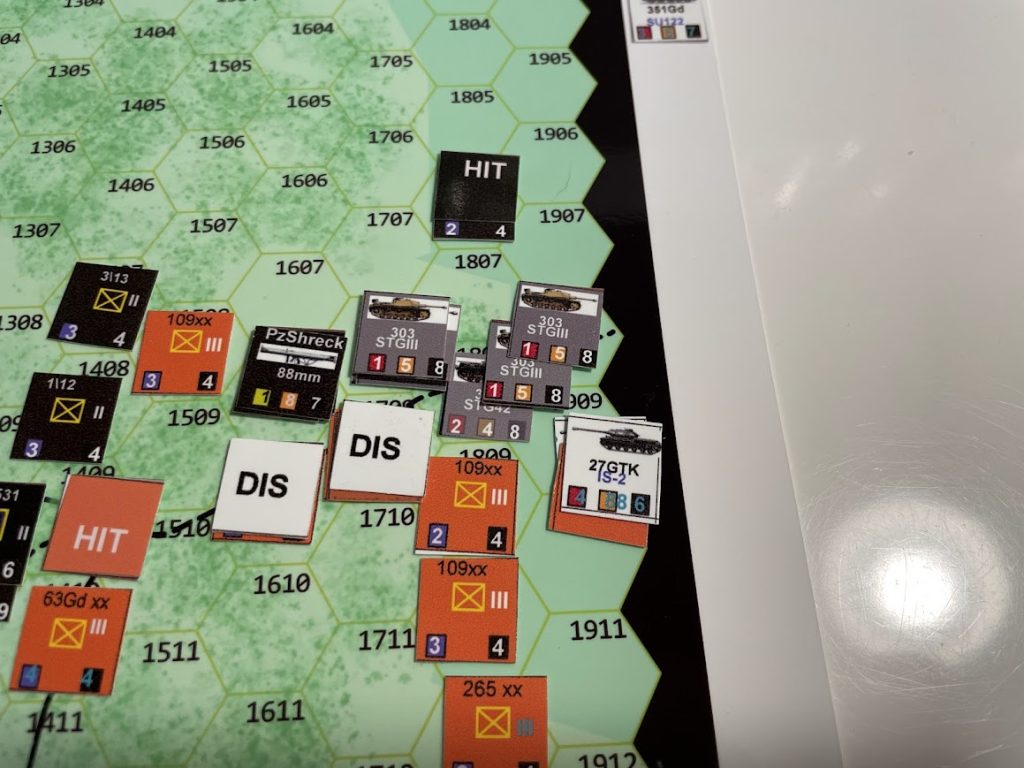
Blocking the Soviet advance. There may be a race to get some units to exit the map for a quick victory. Green is not the standard map color.
The Soviet player wins either by exiting enough units off the map or by having more victory points at the end of the game. Victory points are awarded for capturing villages and towns, as well as for destroying enemy units. Neither path is easy. Because the defender allocates hits, losses can be spread across units in large stacks. I usually played with a house rule to mitigate this, though that was purely a personal choice. For the Finns, success depends on holding as many locations as possible while steadily inflicting casualties on the Soviet forces.
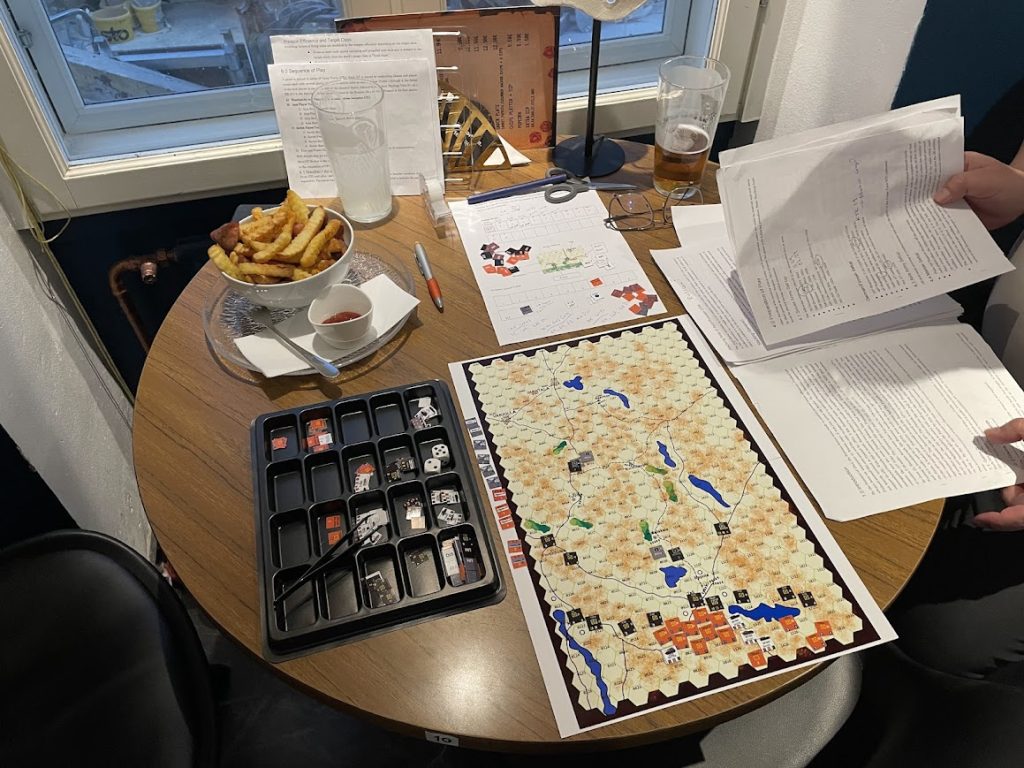
The map is quite compact. Unfortunately, the fries are not included.
A typical session lasted around 4–6 hours for me. I never quite reached the 2-hour playtime that some other testers reported—maybe that’s just me. In any case, you should be able to complete a full game in an evening and still clear the table for something else afterward.
Discover more from Flintlock Games
Subscribe to get the latest posts sent to your email.