
Finnish/Suomi: Nuijasota, Swedish/Svenska: Klubbekriget
A two-player card-driven wargame of Finland’s great peasant uprising
In the winter of 1596, the farmers of Ostrobothnia took up their cudgels and axes against the professional army of Marshal Klaus Fleming. Worn down by years of billeting soldiers through the “castle camp,” and quietly encouraged by Duke Charles of Sweden, the peasants marched south toward Turku to seize the man who ruled them – Klaus Fleming. Within three months the rising was crushed — at Nokia, and finally in the snow at Santavuori. Cudgel War puts you on one side of that desperate, asymmetric struggle.
One player leads the peasant rebels: many, angry, spreading fast, but poorly armed and loosely led. The other commands Fleming’s men-at-arms: trained, castle-based, and few, holding a vast country with too few soldiers. Neither side is strong in the same way, and neither wins by the same path.
How it plays. The game runs twelve turns — one week each — across two phases: the First Rising and the Second Rising. Every turn you draw a small hand of cards and play them one at a time, alternating with your opponent. Each card is three things at once, and you choose which: activation points to spend on actions, a one-off event, or a battle bonus played mid-combat. There are no wasted cards and no hidden bookkeeping — everything that matters sits on the board.
The rebel’s engine is rebellion. Raise a district and it rises in revolt; unwatched provinces next to rebel country may catch fire on their own at the end of every turn. The rebellion track is simply the count of risen districts, and if it climbs high enough – the royalist player may lose the game quickly.
Fleming’s engine is control. He pacifies districts by burning them down, recruits fresh soldiers from his castles, and raises local levies where a leader can call them — but he can never be everywhere. His castles shelter small amounts of troops and can’t be stormed, only turned by treachery; yet hiding behind their walls bleeds his morale as the countryside burns.
Combat is a single, bloody roll of the dice. Each fighting piece throws one die, colour-coded to what it is — trained soldiers hit more easily than farmers — and leaders lend their weight without rolling. Casualties are not all dead but most may return over time back to the game.
Terrain shapes every march. Roads move you fast; forest tracks stop you cold at their end; winter ice-roads open new paths across the lakes — until a thaw closes them. And in the first phase, the empty north is barred to the rebels: the rising must be won on its true ground — Ostrobothnia, Satakunta, Tavastia, Savonia — before the northern coast rises in the second act.
Cudgel War 1596-1597 is a game of two clocks running against each other: the rebellion spreading faster than the crown can stamp it out, and the crown’s army striking harder than the farmers can withstand. History says the cudgels lost. Whether they lose at your table is up to you.
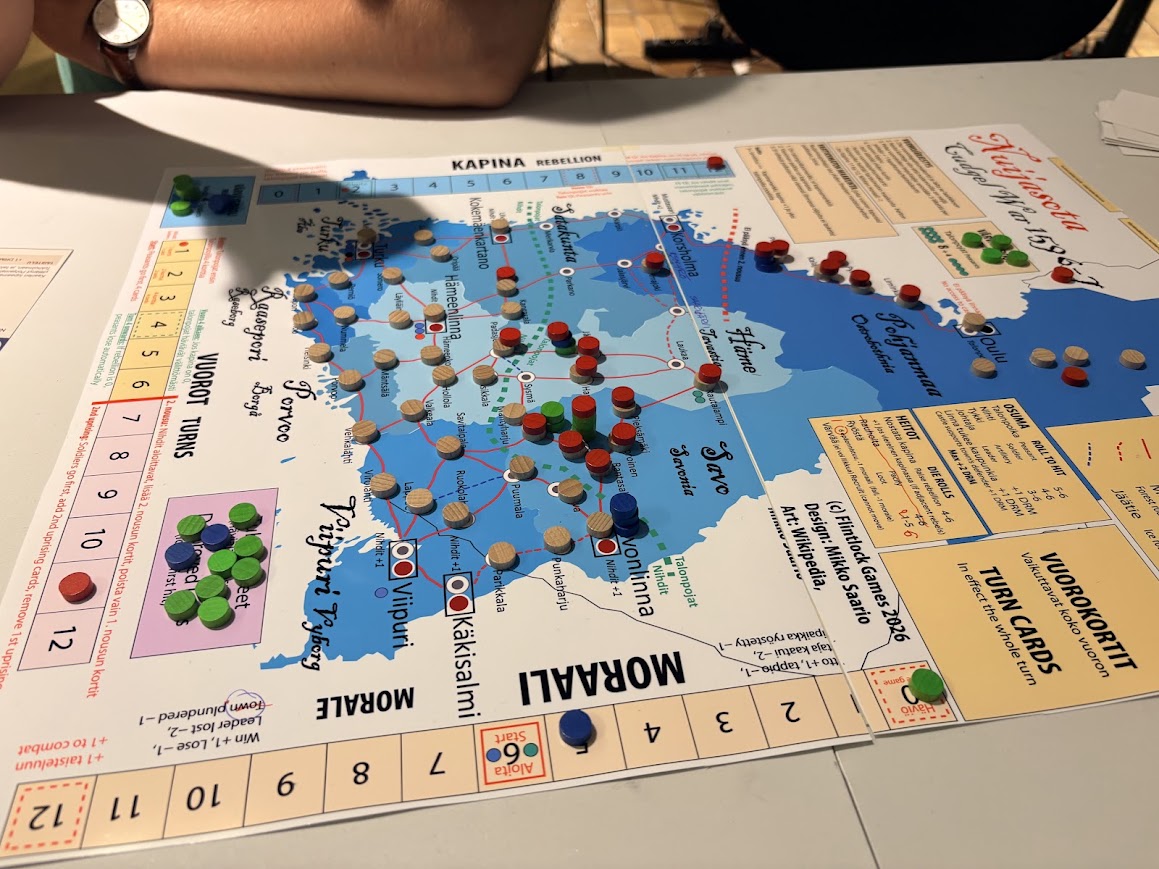
The art is “pre-prod” and for testing. It may, or may not look like this once in completed.